• About
  • Indiana Wineries
  • Michigan Wineries
  • Wisconsin Wineries

Howard W. Hewitt

~ … The "W" stands for wine!

Howard W. Hewitt

Category Archives: Newspaper Column 2014

Explore Those Smaller Wine Regions

22 Tuesday Jul 2014

Posted by Howard in California, Newspaper Column 2014

≈ Leave a comment

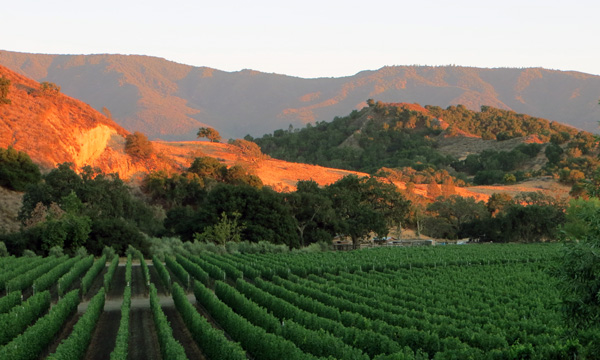
Stunning sunset over the mountains/vineyards of Happy Canyon in Santa Barbara Co., Calif.

Stunning sunset over the mountains/vineyards of Happy Canyon in Santa Barbara Co., Calif.

NAPA/SONOMA Ca. – Repeating the familiar is an easy way to go through life as is taking the safe road. We all do that but find unexpected rewards when taking the path less traveled.

That little bit of philosophy applies to visiting wine country. You can visit Mondavi in Napa or Archery Summit in Oregon and you should. But if you limit yourself to those kind of stops you miss out on the real people and great wine you’ll never find back home.

Grape Sense LogoLet’s face it, you’re not going to run into the owner, winemaker, or much of anyone else at corporate wineries which make their wines by the trucker tank – or for this analogy let’s use the 100,000 case level.

A California trip July 9-19 taught me that lesson over again but can’t be repeated enough. A long weekend in Santa Barbara County resulted in tasting literally hundreds of wines at the 2014 Wine Blogger’s conference. There were several winery names I knew but the defining experience was a dinner trip to Happy Canyon at the far east end of the St. Ynez Valley.

A group of about 20 wine writers visited with six Happy Canyon wineries that most have never heard of before. Grassini, Sloan and more aren’t household names because they produce such small quantity of wine. One of the six was making just 700 cases!

They had good sauvignon blanc but crazy good Bordeaux varietal blends. The far east end, being the greatest distance from the Pacific, results in a warmer climate well suited for Cabernet, Merlot, Cab Franc, and the other French staples.
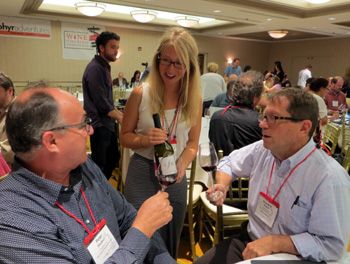
Having fun during the Wine Blogging Conference speed tasting event - crazy!

Having fun during the Wine Blogging Conference speed tasting event – crazy!

The red blends were fantastic wines. The price point was a $50-$80 a bottle but the quality suggested the tiny operations were on point. Obviously, you’re not going to find these wines in the Midwest. But the lesson is small can be good, and very, very good.

There isn’t a wine region in the world that does not have these type of producers. My experience has shown the prices will be a little higher but the wines are usually fantastic. And often the winemaker or owner is the one pouring the juice in your glass.

At those corporate wineries you might luck out and get a really good tasting room employee. But hearing how the wine was made and the inspiration to make it from the winemaker is priceless.

Let’s bring the concept closer to home. Who hasn’t tasted Oliver Winery’s sweet red and white wines? Bill Oliver’s small batch Creekbend Vineyard wines are some of the best you’ll find in Indiana. Better yet, make a trip to the far south and visit Indiana’s other powerhouse Huber Winery. But while there go another 10 miles and visit the quirky Turtle Run Winery near Corydon.
Regardless of the region of the world, wine made in small batches is almost always going to be something special. Think of it this way – would you rather have your soup made in a tub or small pot on grandma’s stove?

 

Share this:

  • Click to share on X (Opens in new window) X
  • Click to share on Facebook (Opens in new window) Facebook
  • More
  • Click to share on LinkedIn (Opens in new window) LinkedIn
  • Click to email a link to a friend (Opens in new window) Email
Like Loading...

Lots of Ways to Chill Summer Wine

29 Thursday May 2014

Posted by Howard in Gizmos & Wine Gadgets, Newspaper Column 2014

≈ Leave a comment

Tags

Angle33, Chill It Bas, wine chillers

A bag of ice or the fridge can keep your wines chilled for any summer outing as easy as any geeky wine device. But if you want something practical and even stylish for summer picnics there are lots of ways to chill your favorite beverage.

Grape Sense LogoWine education should always include some discussion on the proper serving temperature for red and white wine. A general rule of thumb is most people serve white too cold and red too warm. If you put your lighter bodied red wines in the fridge for 10-15 minutes, just to drop them to the upper 60-degree range, you’ll be surprised how bright the fruit will taste.

The proper chilling temperature for white wine is a bit trickier. I recommend putting the bottle in the fridge for 30-45 minutes. You’ll have to experiment. But a word of warning comes with the kitchen appliance solution. Over-chilled wines will not have the same mouth feel or fruitiness as when you get the temperature just right. You want reds in the high 60s, while near 60 is a good temperature for your whites.

But if you’re hosting guests on the patio, picnic table, or porch those wines will warm up in a hurry. A bucket of ice will do the trick but there are some inexpensive solutions which are stylish and fun.

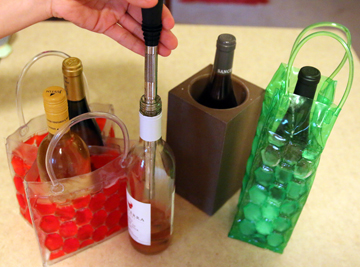
The first of the many outdoor wine chillers is simply the wine bag. These are often give-aways for wineries, wine-related promotions and such. It’s a simple heavy plastic bag big enough for a wine bottle, water and ice. The wine bags are inexpensive, usually about $10. I’ve been given several through the years and they are eye catching on the outdoor table. Perhaps it’s been my bad luck, but the 4 or 5 I’ve tried have all leaked and they’re messy.

There are lots of wine chilling options!

There are lots of wine chilling options!

The next step up in the bag approach is “Chill It Bags” in colorful combinations and walls made of a safe chemical freezing component. You just throw them in the freezer and they’ll keep your wine in great shape. The downside to these bags is when they freeze you must be careful in opening them back up for your bottle of wine. If you force a bottle into a frozen bag you will probably damage the bag. These bags come in multiple sizes and colors and work well. They are also very affordable at less than $10 up to he mid teens.

The insertable chill devices have been big the past couple of years. The insert device is often marketed as wine chiller, winesickle, and more. The devices have a long post which you freeze then insert into the wine. Most have a pour top or a pour/aerator top for a non-messy chilling and glass of wine. The insertable chill devices are usually under $20.

The last chiller is by far the most expensive but guarantees no mess. The Angle33 cement chiller does a great job with style. Yes, it is made of poured cement and weighs about seven pounds. You put the cement chiller in the fridge for 45 minutes, stick the bottle in the cool concrete and your wine will stay nicely chilled for a long while – no water or ice! The downside to the cement chiller is price at $64.99.

So no matter whether you use one of these nifty devices or a bucket and ice, get outside and enjoy those summer white and dry rose’ wines!

Share this:

  • Click to share on X (Opens in new window) X
  • Click to share on Facebook (Opens in new window) Facebook
  • More
  • Click to share on LinkedIn (Opens in new window) LinkedIn
  • Click to email a link to a friend (Opens in new window) Email
Like Loading...

What We Drinking With Dinner?

13 Tuesday May 2014

Posted by Howard in Food & Travel, Newspaper Column 2014

≈ Leave a comment

Tags

fish pairing, food/wine pairing, steak and cabernet

A wine writer’s most-frequently asked question is ‘What’s for dinner?’

More specifically, the question would be what’s to drink with dinner?

Grape Sense LogoThe long-time wine snobbery of many has made the magic of food and wine pairing far more difficult than it needs to be. You can stick with the oldest rule of white with fish or chicken and red with red meat. Or, as many a comic puts it – it you eat it, drink white wine. If it could eat you, drink red!

Another rule is if you like wine A with protein B, forget all of the rules and do what you like.

With that said, we can be more specific. Most people think of summer’s lighter foods rightly but we also drag out the charcoal in summer and put a serious burn on some beast! One of the biggest delights of enjoying wine is getting it just right with the food.

Let’s look at the staples of summer dining:

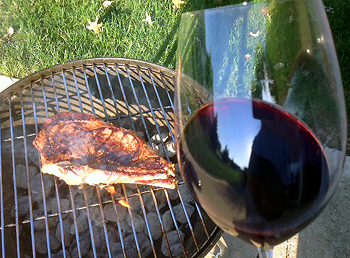
Think BIG - Cabernet - for charred steak!

Think BIG – Cabernet – for charred steak!

Burgers – Everyone enjoys beer with a burger, right? Next time try a French Beaujolais Grand Cru. The Cru wines are priced in the mid-teens, light in body, and are incredible wines for the price. Another choice with a bit more body would be Spanish Tempranillo wines or maybe even a soft Merlot. If you want to stay closer to home with your wine pic choose an Indiana Chambourcin red.

BBQ – If you’re rubbing or lathering up some beef or pork think of that aforementioned Merlot, or if you like bigger wine a Syrah or Zinfandel. Go international and pair grilled BBQ with French Rhone wines, Malbec from Argentina, or even an Italian Super Tuscan (that’s a blend of Cabernet and the native Sangiovese).

Steak – The granddaddy of grilling, rib eye, strip or porterhouse, deserves nothing but the granddaddy of red wine – Cabernet Sauvignon. If Cabernet is too big for your palate then turn to Argentinian Malbec, Chile’s Carmenere’, Saint Emilion Bordeaux, or I enjoy a well-made Syrah.

Pinot Noir or a nice crisp/light Sauv Blanc for salmon.

Pinot Noir or a nice crisp/light Sauv Blanc for salmon.

White Fish – Lighter fish is where preparation means everything. Most grilled white fish will pair well with Sauvignon Blanc. But be adventurous and try a Midwestern Pinot Blanc or Vidal. The emerging stainless steel chardonnays are perfect for white fish. Be really crazy and try an Albarino from Spain or Portugal. Be the talk of the cookout and pop open a bottle of Italian Vermentino. All of these whites are easy to find in a good wine shop for under $20.

Salads – Summer salads can be delightful with floral wines. Try a domestic or French Viognier with your salad. If there is protein (chicken or shrimp) in your summer salad, seek out the Albarino mentioned above. A good dry Rose’ gives that salad lunch a real continental feel. The sales of Rose’ continue to explode each summer. Buy a French Provence Rose or a domestic Rose’ of Pinot Noir and you’ll see why they’re flying off shelves everywhere. The Sauv Blanc is always a solid fall-back position.

One of the key strategies in wine and food pairing is to not forget the sauces, rubs, and side dishes. Think of each entire dish when selecting your wine and you’ll have many enjoyable summer moments.

Share this:

  • Click to share on X (Opens in new window) X
  • Click to share on Facebook (Opens in new window) Facebook
  • More
  • Click to share on LinkedIn (Opens in new window) LinkedIn
  • Click to email a link to a friend (Opens in new window) Email
Like Loading...

Chilean Wine Keeps Improving

02 Wednesday Apr 2014

Posted by Howard in Newspaper Column 2014, South America

≈ 2 Comments

Tags

Bonarda, Carmenere, Grey Single Block, Malbec, Ventisquero, Wines of Chile

South American wines played a key role in revolutionizing the concept of value wines in recent years. Argentina has had great success with its seductive Malbec, earthy Bonarda, and even the white difference of Torrontos.

Grape Sense LogoChile has been around longer but may be viewed more skeptically by growing mostly Cabernet, Syrah, and Merlot wines. Early on much of the Chilean Sauvignon Blanc was quite tasty. But the reds were marred with a green pepper or vegetal flavor that was a little more than unappealing to many palates.

The Chilean wines I’ve tasted in the past year are increasingly of higher quality and interest. Chilean winemakers are also experimenting with Pinot Noir and even Rhone blends. The unique and different growing regions could make Chile a real wine star in coming years.
A little background goes all of the way back to the 16th century and Spanish conquistadors introducing vines to the coastal nation. In the 1800s the French introduced Cabernet, Merlot, Cab Franc, and a somewhat obscure grape, Carmenere.

Keep in mind when thinking about the environment for grape growing is the unique terroir. The Andes and the Pacific Ocean sandwich the grape growing regions. That would be latitudes similar to Spain.

There are five major wine regions, arguably the Central Coast produces the best wines or at least the wines most often found on U.S. shelves. The Central Valley includes the three Maipo regions along with the best known Colchagua Valley area.

Some important folks and winemakers have taken notice of Chile’s potential in recent years through partnerships and investment. Robert Mondavi, Miguel Torres, Chateau Lafite Rothschild, and Chateau Mouton Rothschild have all partnered to make wines.

WinesChileLogoGreat Britain imports a lot of Chilean wines and even the higher end bottles. In the U.S., Chilean wine normally means value – or frankly, cheap red wine.

Where Chile may have a long-term advantage is the diversity of its wine industry. The Cabernet, Syrah, and Merlot wines are certainly a bit different than pulling one off the shelf from California. That little-known French blender Carmenere has been adopted by Chile as its signature grape. Carmenere is big, inky, deep purple wine that can be over-powering to silky and alluring.

The bottle line is affordable Chilean wine wasn’t all that good just a few years ago but it’s improving fast. It’s time to revisit the South America section of your wine store, move past Argentina for now, and try the improving Chilean wines.

Some names I can recommend: Montes, Errazuriz, Casa Silva, Miguel Torres, Terra Andina, Santa Ema, Carmen and Ventisquero.

The Ventisquero wines are at a slightly higher price point than many, they are really knockout wines. I received these wines as a trade sample.

Grey Single Block Carmenere – Blueberries, blackberries, smoke and spice make this a seductive glass of wine. It spends 18 months in new oak and is the kind of big wine that pairs really well with big food.

Grey Single Block Cabernet Sauvignon 2011 – The 96 percent Cab, 4 percent Petit Verdot wine was a wonderfully bold Cabernet with beautiful balance.

Grey GCM 2011 – This was the surprise of the lot for me. I had not had Rhone varietals from Chile and this wine blend of Garnacha, Mourvedre, and Carignan showed tremendous potential.

This label is widely available with all three wines at a suggested retail price of $23.99.

Share this:

  • Click to share on X (Opens in new window) X
  • Click to share on Facebook (Opens in new window) Facebook
  • More
  • Click to share on LinkedIn (Opens in new window) LinkedIn
  • Click to email a link to a friend (Opens in new window) Email
Like Loading...

Wine Returns to Indiana State Fair

16 Sunday Mar 2014

Posted by Howard in Newspaper Column 2014, Wine Education/News/Updates

≈ Leave a comment

Indiana winemakers are anxious to pour their wines at the Indiana State Fair. Hoosier grape growers are ready to stand alongside Indiana’s other agricultural producers.

Grape Sense Logo“I think this is a recognition that grapes and wine are an Indiana agricultural product deserving of all the pride and local support that other Indiana ag products have,” said Jim Butler, owner/winemaker of Butler Winery, Bloomington. “It shows that Indiana is keeping up in this rapidly changing world.”

Indiana Governor Mike Pence signed the bill into law late Friday.

Jeanette Merritt

Jeanette Merritt

“We have been so fortunate that our Governor, Lt. Governor and Indiana State Department of Agriculture understand and appreciate our role amongst other commodities in the state,” said Jeannette Merritt, marketing director for Indiana Wines & Purdue Wine Grape Team. “I am thrilled that we will be represented and able to educate people on the grapes planted and the wines made from those grapes.  We will reach a huge audience who can enjoy and learn about our industry.”

Indiana’s wine industry continues to grow, strive for recognition, and build a substantial economic base from border to border. There are now 80 Indiana wineries generating an economic impact of more than $3 billion, according to an analysis by New York-based John Dunham and Associates.

There still seems to be some uncertainty of how the State Fair will implement wine and beer at the annual exposition. It certainly will be a restricted area. State fair officials have said they would expect Indiana winemakers to take an education approach to pouring their wines. That would indicate that “tasting’ would be a more appropriate term than having a glass of wine but no final decisions have been made. A legal ‘taste’ of wine in Indiana would amount to no more than a 1-ounce pour or what visitors get in a tasting room.

Jim Butler

Jim Butler

Indiana winemakers are cautious but anxious to participate at some level.
“If there is an “Indiana wine appreciation day” then it would be the place to be,” Butler said. “It would be a great chance to get our product out in front of people who are looking at other Indiana agricultural products.  It all depends upon how it is set up and organized. Wineries are limited to 45 festival permits per year. I can envision doing a day, two at the most, but not the entire fair. Festivalsare a lot of work!”

Dan Adams, owner/winemaker, Winzerwald Winery, Bristow, believes the legislation helps promote tourism, agriculture, and rural development. “We look forward to being able to promote our great value-added products to all the great fair supporters,” he said. “It gives us an opportunity to tell our story and showcase our products to people who enjoy the same things we do – farming, family and fun.”

Jim Pfeiffer

Jim Pfeiffer

Turtle Run winemaker/owner Jim Pfeiffer takes it a step further. “It shows our wine quality over the years has reached the level of national and international wines,” the Corydon-based winemaker said. “Mostly though, it indicates that Indiana consumers have a preference for our wines.”

Pfeiffer was uncertain how Turtle Run would participate but confident he’d be a part of the new exhibit.

Share this:

  • Click to share on X (Opens in new window) X
  • Click to share on Facebook (Opens in new window) Facebook
  • More
  • Click to share on LinkedIn (Opens in new window) LinkedIn
  • Click to email a link to a friend (Opens in new window) Email
Like Loading...

Get White Right with Your Sauce

08 Saturday Mar 2014

Posted by Howard in Food & Travel, Newspaper Column 2014

≈ Leave a comment

Tags

Chicken Lyon, Chicken Lyon recipe, food and wine pairing, unoaked Chardonnay

Everyone has heard the old wine/food pairing advice of red wine with red meat and white wine with fish or chicken.

Grape Sense LogoFor the most part, that’s not a bad guideline which will work more often than not. But as you really get into wine and start referring to yourself as a “foodie,’ the simplistic advice just won’t work.

From time to time in coming months Grape Sense will explore food and wine pairings with easy-to-make recipes. More on that in the future.

The first example is baked chicken and white wine. But what if your chicken dish has a rich and creamy sauce? That big oaky, buttery, California-style Chardonnay is probably not a great match.

An ideal pairing for such a dish is an unoaked Chardonnay or lightly oaked Chard. Think French Chablis or Oregon or even the inexpensive unoaked Chards from California and Washington state.

The unoaked Chardonnay will give you bright fruit with a fresh taste but a nice acidic and crisp finish. That finish is the perfect complement to the creamy sauce on a dish like Chicken Lyon.

LyonGood unoaked Chardonnay can be easily found in the $12-$20 range in any decent wine shop. Great Oregon unoaked or lightly oaked Chard runs $25-$50. French Chablis, arguably the world’s best white wine, starts in the teens and runs into the $100-range. Try a Chablis Premier Cru for around $30-$45 on a special occasion.

If you want to avoid a Chardonnay then go to many of the lighter white but zesty and crisp whites like Oregon Pinot Gris, Spanish Verdejo, Rhone or Languedoc whites, or even This recipe is a great test for your unoaked Chard. It’s not mine, it’s a compilation of Chicken Lyon recipes I have found and like.

Chicken Lyon

One Medium Chicken, cut up

3 tablespoons olive oil

3 tablespoons of real butter

12 large garlic cloves, unpeeled

A bay leaf or two

1 cup of vinegar, I prefer red wine vinegar

2 cups chicken stock or broth

1/4 cup cream, half&half or creme fraiche

1. Preheat oven to 425. In deep skillet put olive oil and brown chicken skin side down. Add salt, pepper, a tablespoon of butter and brown the chicken. Flip the chicken and add all that garlic and bay leaf.

2. Remove the skillet and into the oven it goes for about 10 minutes (no longer). I make this dish in an iron skillet. Add the vinegar and cook 15 minutes or until you think the chicken is done. Remove from oven.

3. Now, take chicken from the skillet and set aside. Add the chicken stock, scrape up the tasty little bits left behind and let it reduce to a little more than a cup. That will probably take 5-10 minutes. Add your cream and remainder of the butter – whisk it all up. Return chicken to the pan and let it cook until the sauce begins to thicken. That will take about 5 minutes.

Serve it up. If you want a French country meal feel to your Chicken Lyon, roast some nice asparagus with garlic and butter.

Share this:

  • Click to share on X (Opens in new window) X
  • Click to share on Facebook (Opens in new window) Facebook
  • More
  • Click to share on LinkedIn (Opens in new window) LinkedIn
  • Click to email a link to a friend (Opens in new window) Email
Like Loading...

Wines News Impacts Consumers

18 Tuesday Feb 2014

Posted by Howard in Newspaper Column 2014

≈ Leave a comment

News from the world’s wine regions can affect even the average wine drinker. There is a lot going on, particularly in California, which can affect future wine prices.
The biggest news and fear from the west coast is the on-going drought. The 2013 harvest was huge but vineyard owners and managers are concerned about the future.

Grape Sense LogoNorthern California had a heavy five days of rain recently but it was not nearly enough to offset dry conditions. The extended rainfall certainly brought about some sighs of relief but long-term weather predictions call for dryer than normal conditions until at least early summer.

Anyone in the Midwest knows what happens with agriculture when things dry up. There are smaller crops and less quality product. That is doubly true with fruit, or in this case grapes. No one is predicting a catastrophic 2014, particularly on the heels of a strong 2013 crop, but it bears following.

Each year the USDA’s National Agricultural Statistics Service provides a harvest report and it’s always interesting reading. California’s 2013 crop was up six percent over the previous year. That means more than four million tons of wine grapes were harvested.

What’s the top grape in California? Well, most people would probably guess its Cabernet Sauvignon but actually there is more Chardonnay being harvested each year. Chardonnay accounts for 16 percent of the harvest to Cabernet’s 11 percent. Zinfandel comes in at 10 percent of harvest followed by Merlot, Pinot Noir, and Pinot Gris.

And to understand wine prices, or the price of any consumer good, you have to have an appreciation for raw material costs. Everyone learned that in basic Economics, right? California is best known for its big, expensive Cabernet wines. Well, the average price for a ton of grapes in California was $706.29 a ton. But if you have Cabernet on those acres the average cost is $5,500 per ton.

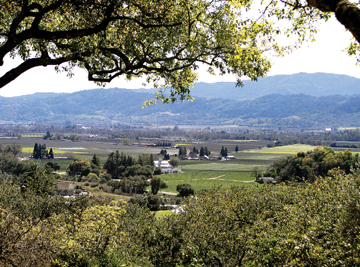
A great look at the floor of Napa Valley in March.

A great look at the floor of Napa Valley in March.

So how much wine does that make? It depends on a lot of variables, obviously. But if we just take averages you have to crush 600-800 grapes to make a bottle of wine. That could be anywhere from three to 10 clusters. It takes a little more than 30 pounds of grapes to make a case.

Do you have your calculator out yet? That means you can make approximately 750 bottles of wine from a ton of grapes. Now get your calculator out and you begin to see the differences in the cost of a bottle of wine from label to label. There are many other variables but it all starts with raw materials.

Two other interesting stories center in Napa/Sonoma. There is quite the community battle underway in Sonoma over how many tasting rooms are too many. On three trips to Sonoma, I’ve noticed an increase around the charming town square during each visit. Some fear it’s chasing out small business while winery owners and the wine industry contends all those tourists keep the town alive. That one will be an interesting one to follow.

The other is a much needed discussion about rebuilding Highway 29, the main street of wine country in Napa. The road looks like a Midwestern two-lane highway through the middle of all these multi-million dollar winery operations.

After a year-long study, a presentation has been made to local government officials to rebuild the famous 17 mile stretch with front roads, bicycle paths, sidewalks and more. Don’t look for Napa wine prices to go down in our life time. The cost for that local project is projected to be $349 million.

Share this:

  • Click to share on X (Opens in new window) X
  • Click to share on Facebook (Opens in new window) Facebook
  • More
  • Click to share on LinkedIn (Opens in new window) LinkedIn
  • Click to email a link to a friend (Opens in new window) Email
Like Loading...

Wine for Serious Wine Lovers

04 Tuesday Feb 2014

Posted by Howard in Italy, Newspaper Column 2014

≈ Leave a comment

Tags

Arnaldo Caprai, Marco Caprai, Sagrantino, Tabarrini, Umbria

It’s easy to buy a big, expensive California Cabernet, red Bordeaux, or Oregon Pinot Noir for an intimate dinner party or special gift. But to really surprise a serious wine lover or yourself why not something really different?

Grape Sense LogoOdds are even the biggest wine fans are going to scratch their heads when you present them with a bottle of Sagrantino. The grape grows primarily in just one region of the world. Sagrantino’s home is the hilltops around Montefalco, Italy. Its origins are largely unknown though it’s been suggested it arrived in Umbria from Greece. There is also a school of thought the Franciscans or St. Francis of Assisi brought the grape from the Middle East as a scacramental wine. The grape can be traced back 400 years in the Montefalco region.

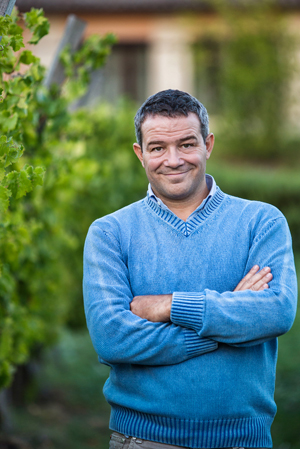
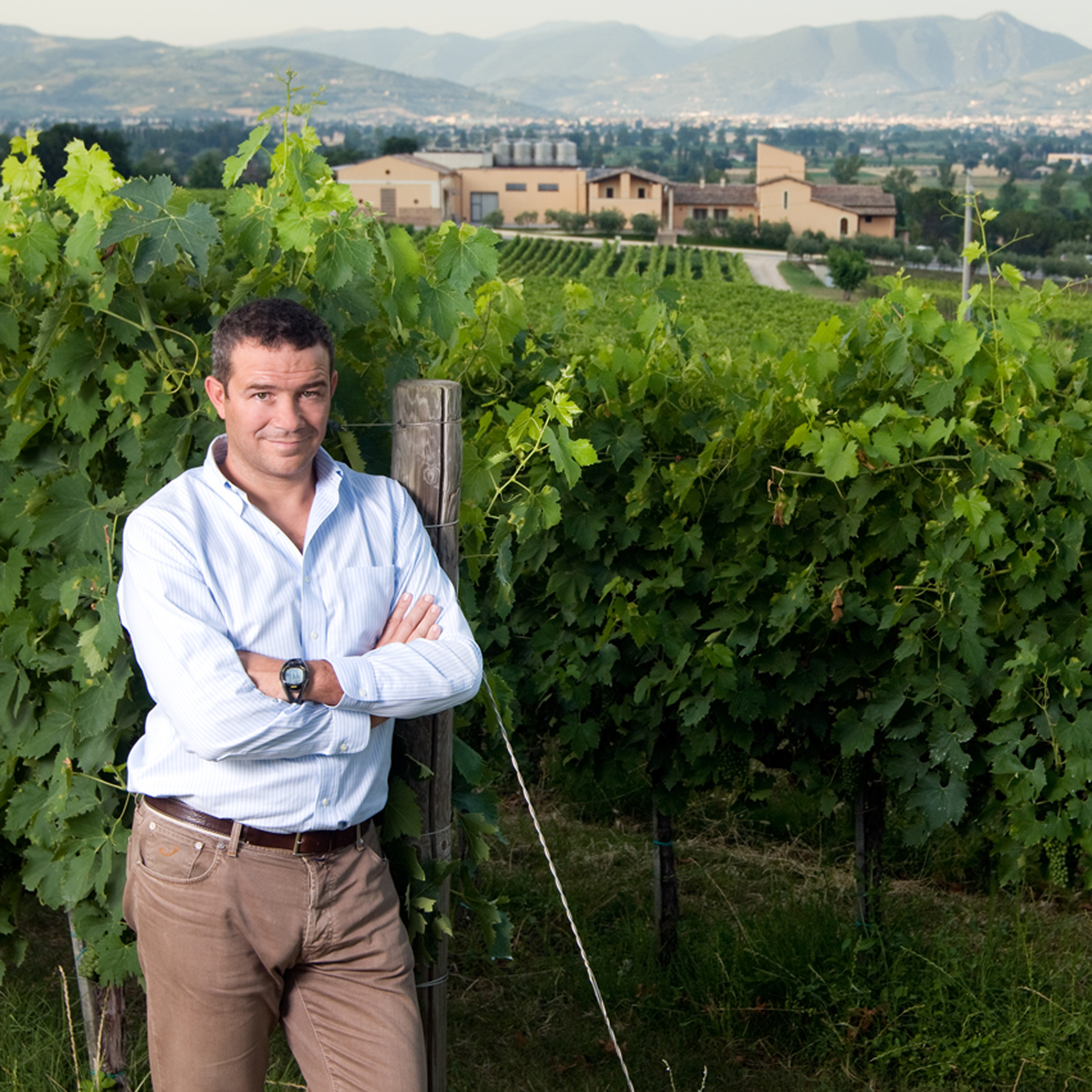
Winemaker Marco Caprai

Winemaker Marco Caprai

What makes the wine special and rare is that there is only 250 acres of Sagrantino in the region. A bit of Sagrantino is planted elsewhere in Tuscany but not much. There are only a few producers specializing in the wine. The number is usually reported as about 25 wineries.

Sagrantino is often blended with a large percentage of the traditional Italian Sangiovese grape to make a Montefalco Rosso; Sagrantino Passito is made from partially dried grapes.

But let’s stick to the rare but exciting 100 percent Sagrantino.

What’s so special? It is big, rich, and dry wine. It probably will be the most dry wine even an experienced wine fan has ever tasted. It is extraordinarily complex wine worthy and demanding aging before drinking. Most recommendations range 5-10 years beyond vintage year before consumption.

The wine is aged at least 30 months before it can be released. It’s a full-bodied wine driven by muscular tannins, rich taste, and subtle floral hints.

Caprai with family estate in the background.

Caprai with family estate in the background.

Such an obscure and difficult grape requires a champion. Arnaldo Caprai is the little black grape’s biggest booster. For years Caprai made his substantial living as an Italian textile giant. He bought a winery in the 1970s near Montefalco. Caprai partnered with the University of Milan to study the grape and its background. Marco Caprai joined his father’s efforts in 1987 as they expanded vineyards and built a state-of-the-art winery. He continues as the winemaker and Sagrantino ambassador today.

The Caprai wines are the best among four to five labels I’ve tasted.The wines would pair well with Italian-seasoned beef, or meat in red sauces, this is not pasta wine! The latest Caprai Sagrantino release was a consistent 90-94 point wine

There are other labels available in the U.S. but you’ll only find Sagrantino in better wine shops.

I opened a bottle of Tenuta Alzatura Disente Uno 2004 Sagrantino for this column. It was a bit silkier than most with a strong sense of earthiness on the nose. Frankly, it was a little thin. It still had the huge tannic finish but wasn’t as rewarding as others.

The second bottle I tested was Tabarrini 2006 Colle Grimaldesco, aged 24 months in oak and 12 months in the bottle before release. This wine had the intense dark colors and a dense taste of blackberry and spices. It warms the palate and surprises a novice with its sheer power. Wine Advocate gave this wine 91 points.

Grape Sense has always focused on value wine. But the least expensive Sagrantino is around $30 and you can easily spend up to $150. So Sagrantino is not for everyone, but something really special to give a try if you see a bottle.

This piece is my most recent newspaper column. A similar and slightly longer piece appeared in the most recent issue of Madison Magazine, Anderson, In.

Share this:

  • Click to share on X (Opens in new window) X
  • Click to share on Facebook (Opens in new window) Facebook
  • More
  • Click to share on LinkedIn (Opens in new window) LinkedIn
  • Click to email a link to a friend (Opens in new window) Email
Like Loading...

Plenty of Great Wine Under $20

20 Monday Jan 2014

Posted by Howard in Newspaper Column 2014

≈ Leave a comment

Tags

Lenore, Owen Roe, Syrah, Washington State

The seven years this column has focused mostly on great wines under $20 that you won’t find on the grocery shelf. Every time it seems like the list is exhausted, another wine comes along to make even the wine cynic say ‘wow!’

Grape Sense LogoFor regular wine drinkers finding such a wine is the thrill of the hunt. Always on the lookout for a wine that rocks for a low, low price, the real enthusiast treasures the unexpected find.

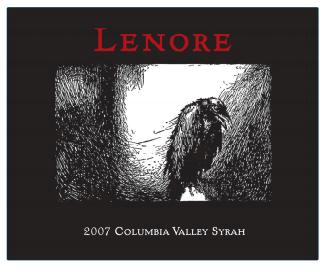
Lenore Syrah, from Washington State, might be the best value wine I’ve tasted in years. First a little necessary background is in order. Washington is really turning the heads of value wine drinkers. The wines tend to be full, rich, less tannic, value priced, and imminently drinkable.

One of the biggest names in Washington wine is Owen Roe. Owen Roe was a 1600s Irish patriot who was known for his dedication to principle and not compromise when seeking the best of any pursuit.

It’s that dedication modern-day winemaker David O’Reilly and vineyard manager Jerry Owen bring to their Washington wines. The Owen Roe label – which includes Syrah and a number of red wine blends – sells mostly in the affordable $20-$30 range.

But like many wineries Owen Roe has a ‘second-tier’ or value label. That is more common in the wine industry worldwide than some wine drinkers may realize. The value label is Corvidae-Lenore. Corvidae is Latin for the family of birds including ravens, magpies, and crows. “Their reputation as crafty, adaptable, and somewhat dubious characters is a fitting icon for our suspiciously terrific value wines,” the winery website suggests.

LenoreThe Lenore 2011 Columbia Valley Syrah features a Raven and embraces the legacy of Edgar Allen Poe. The wine is a real thriller.

It has wonderful fruit without being over-powering, wonderful spice, and a mouth feel that will have you headed back to the shop for more. I found this wine to be such a bang-for-the-buck I would have bet it was a $30-$40 bottle if I had tasted it blindly.

The suggested retail is $16.95 and I found it online cheaper than that.

This wine is a wonderful pairing for winter stews, roasted meat, or even chili.

Other Washington Syrah value labels include: Sparkman,  Southard, Fausse Piste, Trust, Betz Family, Abacela, Spring Valley, Saviah Cellars, Dusted Valley, and many, many more.

Paso Robles on California’s Central Coast is another region known for its outstanding Syrah. The fruit is bigger and so is the finish but the value at a slightly higher price than Washington is still there in the next price tier.

Look for labels like Eberle (the Godfather of California Syrah), Tablas Creek, Saxum, Calcareous, L’Aventure, and many more. But one of the great ways to enjoy Syrah is from Paso Robles’ great Syrah blends using traditional Rhone grapes like Grenache and Mourvedre.

If you want something simple, cheap, and very easy to drink and find – then try the French Les Jamelles Syrah. It’s certainly not as well-defined wines as any mentioned here but it’s very drinkable and almost always under $10.

Syrah has been a much maligned grape in recent years but try it with hearty winter meals and you just might become a fan.

Share this:

  • Click to share on X (Opens in new window) X
  • Click to share on Facebook (Opens in new window) Facebook
  • More
  • Click to share on LinkedIn (Opens in new window) LinkedIn
  • Click to email a link to a friend (Opens in new window) Email
Like Loading...

Looking into 2014 Crystal Ball

06 Monday Jan 2014

Posted by Howard in Newspaper Column 2014

≈ 1 Comment

Tags

Michigan wine, Moscato, Oregon, Willamette Valley, wine travel

crystal-ball

The only good thing about looking forward at the start of the year is no one remembers your predictions a week or so later. That said, there are lots of trends and movement in the wine world which will have an impact on the average wine drinker.

Grape Sense LogoFor the first Grape Sense of 2014, it makes sense to look ahead a bit.

Moscato – That sweet white wine that seems to be everywhere is exploding. But that’ s not news since it all started in 2012. Sales increased by a third in 2012 with little sign of letting up in 2013. The light alcohol and light fizz has proven wildly popular with younger consumers.

From hip-hop artists to long-time sweet wine lovers, Moscato has become the go-to beverage. California is providing most of the sweet white but look for other labels to join the band wagon. Furthermore, check out your local grocery, wine shop, or liquor store shelves and you’ll find major labels offering a variety of sweet wines.

Red wine blends are another area continuing to expand and grow. A good red wine blend can go from the inoffensive to nuanced and satisfying to even the most discerning wine drinker. Better yet, you can often get big bold flavors from a good California or Washington blend at a fraction of the cost of single variety wines. Red wine blends offer some of the best value options for better wine.

The biggest sales growth areas are Moscato, sweet red blends, and Malbec. Malbec is a great intro point for those trying to expand beyond Cabernet, Merlot and Pinot Noir. It’s a great food wine and a wonderful way to start exploring beyond your normal tastes.

wineappMillenials and apps have been the talking points for much of the wine media over the last few years. Younger people are the fastest growing segment of the wine-buying population. They do drink sweeter wines but they are also very willing to try something new.

The younger section of the market is also driving wineries, marketers, and everyone else in the wine business to go more digital. There are smart-phone applications to find wine, rate wine, and journal your own wine drinking.

Packaging is another area where innovation continues to push the market. Wine is turning up on shelves, particularly value wine, in single servings, all shapes of paper and glass containers, and other new ways to supplant the 750ml bottle.

wine-celeb_ticketsand Indiana to get the world’s attention with its small production of wine. But the quality of the ‘other states’ wines continue to improve. Each year I visit quite a few Indiana wineries, and a few in surrounding states, the quality continues to show considerable improvement. It’s not just the top producers but some of the smaller state wineries have learned to focus on quality.

Wine travel is a great vacation and another industry that just grows and grow. I will be joining that trend in 2014 by leading a boutique-type experience in Oregon’s Willamette Valley in June. Whether it’s a trip you plan yourself or an organized wine adventure, the internet has really made it easy to plan a great wine vacation. Click here if you’d like information on the Oregon trip I’m hosting or simply to add your name to my mailing list for future trips.

Happy New Year to all. Thank you for reading Grape Sense!

Share this:

  • Click to share on X (Opens in new window) X
  • Click to share on Facebook (Opens in new window) Facebook
  • More
  • Click to share on LinkedIn (Opens in new window) LinkedIn
  • Click to email a link to a friend (Opens in new window) Email
Like Loading...
Newer posts →

Recent Posts

  • The other White Burgundy – Aligote!
  • Some wine gifting advice
  • Real Indiana Chardonnay?

Categories

Enter your email address to follow this blog and receive notifications of new posts by email.

Join 2,063 other subscribers

Photography

Friend Me On …

Archives

My Summer With Lymphoma: Lymphoma - My Third Battle 2024

Scan: ‘No Evidence of Disease Progression’

That’s a nice way to say it. Yesterday, Mar 27, I had a PET scan (nuclear medicine) to look for cancer after my 60-day CAR-T cancer treatment. The headine here was the second sentence in the technical and detailed report. I really didn’t need to read anymore. I am cancer free and now can wear […]

Fighting Disappointment, Wrist Pain

Most of the past week or so has been dealing with the disappointment. I ended my 60 days of restrictions from cell therapy cancer treatment. But I learned a severely broken wrist can even out do cancer. I fell Sunday Feb. 19 in an icy parking lot. I had surgery the following Wednesday then Thursday, […]

Blog at WordPress.com.

  • Subscribe Subscribed
    • Howard W. Hewitt
    • Join 87 other subscribers
    • Already have a WordPress.com account? Log in now.
    • Howard W. Hewitt
    • Subscribe Subscribed
    • Sign up
    • Log in
    • Report this content
    • View site in Reader
    • Manage subscriptions
    • Collapse this bar
 

Loading Comments...
 

    %d