A few postings back, I wrote about Vino 100 on the northside of Columbus, Ohio. I’ll be making another stop this Friday but always enjoy visiting with Liz in her one-year old wine establishment.
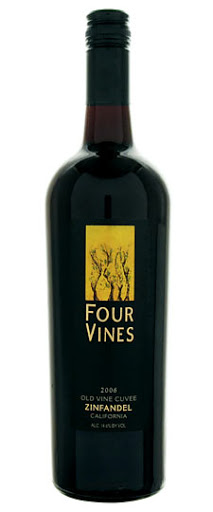
Last time there I asked for a couple of recommendations on some really big wine. She pointed me to a California Syrah, which is still on the rack, and the Four Vines 2006 Old Vine Cuvee Zinfandel.
So I opened that one tonight while I started to prepare some pasta. It had been open about a half hour when I took a little sip and I didn’t think much of it. It was a little all over the place – the fruit, the acidity …. but I decided it just might get better with a little time.
After it had been open a little over two hours, the wine opened up and was pretty good Zin. It was a big fruit-forward Zinfandel with hints of oak. I felt like the finish didn’t have the pepper of some Zins but it was a good bottle of wine.
The Cuvee is made from grapes grown in California from the Mendocino, Amador, Paso Robles and Lodi regions.
I paid $14.95 for this bottle and would recommend it at that price point for those that like a little bigger Zin. Now, this isn’t huge like some of the real fruit bombs California produces, but a bigger stronger wine than you normally find at this price point.
Send comment or questions to: hewitthoward@gmail.com
I opened a 2007 Dona Paula Malbec over the weekend and was really impressed with its quality for a $12.99 wine.
The wine has a beautiful nose that is dark burgundy in color. On the palate you get dark berries and maybe something like plum. It is rich and smooth like a nice piece of chocolate.
The tannins were mild with a lingering finish. You won’t notice much acidity with from this dynamic young winery. It’s hard to imagine any Malbec lover not enjoying this lovely red wine.
This wine has been noticed by the critics. It has consistently been rated around 90 points on the oft-used 100-point scale. I most recently saw it at The Bottle Shop in West Lafayette but it is widely distributed.
Dona Paula started its operation in 1997. The resume of the estate’s three winemakers is impressive. The trio studied winemaking in Chile, France, Italy, and Argentina. Dona Paula also has a beautiful website. Check it out here.
Malbec continues to just explode. I came across an interesting factoid that 40 percent of Argentina’s wines now come to the United States. Exports here tripled between 2002 and 2006.
Send comment or questions to: hewitthoward@gmail.com
Yes Virginia, there is wine made across the country in places other than California, Oregon, and Washington State. I found an interesting site the other day http://www.drinklocalwine.com that emphasizes just that point.
The good folks running the site linked to my most recent entry on Turtle Run. Check out the website.
Send comment or questions to: hewitthoward@gmail.com
Jim Pfeiffer, owner and winemaker, at Turtle Run Winery near Corydon in Southern Indiana prides himself on the unique taste of his wines.
This summer he talked about his approach never wanting to do the same Chardonnays and Merlot everyone else produces. The self-described Picaso, or mad scientist, invites winery visitors into his production area while he is mixing and blending and dreaming up his latest creations.
One of his most successful blends is Dry Tortuga. It is a non-vintage wine of 72 percent Chardonel and 28 percent Vignoles. Now, lets stop here to talk about those two grapes. Chardonel is often compared to Chardonnay, but its a grape that is heartier than traditional Chard grapes; therefore, easier to grow in Indiana. The taste characteristics are similar. Vignoles is going to be really different to those who’ve never tasted it. Vignoles is a hybrid grape. It makes sweet wines with a bouquet of flowers and usual low acidity.
During a July visit Pfeiffer was blending the two grapes and trying a shot of Sauvignon Blanc. At one point he added intentionally over-oaked Chardonel. He tried a pinch of sugar. He did a little bit of everything that day. Later I learned he tossed the formula he settled on and started over.
I opened the Dry Tortuga tonight and it is different, but in a good way. I found I enjoyed it with food more than alone. It has some hints of vanilla and orange but, frankly, I really struggled to put my finger on why I liked it so much. You’ll be reminded of Chardonnay. It is definitely a dry wine. The description of the grapes might make you think sweet but Tortuga definitely is dry wine.
I had it with some shrimp and angel hair pasta with garlic. It matched perfectly. The Dry Tortuga sells for $15. The wines can be hard to find unless you’re really close to Southeastern Indiana.
Pfeiffer’s wines offer a lot of different taste characteristics than the other 42 Indiana wineries. Another example is “Red My Mind.” Pfeiffer combines Merlot and Chambourcin and comes up with a red wine that has characteristics similar to Pinot Noir. Crazy? Yes! But delightfully different! A visitor might not like all the taste combinations, but all are well made and something new from an exciting young winemaker.
Send comment or questions to: hewitthoward@gmail.com
Ruffino is one of the most recognizable names in the wine world. The iconic Italian brand has been making Chianti – in bottles wrapped like a basket – for decades. The basket bottle is gone but a century-plus-30 years of winemaking delivers a really nice glass of Chianti for the price point.
I wrote about the Ruffino Chianti, their most basic wine, just a couple of weeks ago.
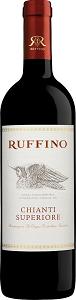
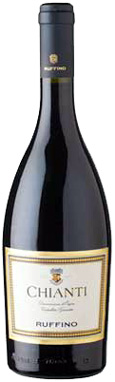
The latest bottle is the Ruffino 2007 Chianti Superiore. I’d call it a cherry bomb! No it’s not the kind we older folk remember from youthful Fourth of Julys, or even the one John Mellencamp sang about in the 1980s. The Sangiovese blend has really bold notes of cherry.
The wine has nice balance and a smooth finish. Old world wineries are learning from many of the new world winemakers. This Chianti is aged in stainless steel but no oak.
The Superiore is 75 percent Sangiovese with the other 25 percent including Canaiolo Nero, Cabernet Sauvignon, and Merlot – all within Italian regulations for Superiore production.
The result is a fairly simple but nicely-flavored Chianti Superiore that is bolder than the $9 Chianti and will hold up a better to big flavored pasta dishes.
It’s obviously a young wine from the old world but one that is easy to drink with a smooth feel on the palate and a mild acidity. The alcohol is certainly in check at 13.5 percent.
As I previously wrote, trying these Ruffino wines is like rediscovering an old friend. The recommended retail on the Superiore is a very reasonable $12.99. I found it on the internet anywhere from $9.99 to $15.99.
In the spirit of full disclosure: I received these wines as samples from Ruffino’s marketing arm in New York!
Send comment or questions to: hewitthoward@gmail.com
Tonight I’m letting my inner Julia Child, or is it Bobby Flay, come out to talk about and share a recipe.
I made a trip Sunday to Huber and Turtle Run wineries in Southern Indiana. It’s a crazy time of year for the southern Indiana folks who all seem to host fall festivals. The crowds at Hubers are fun, exciting and really big. As a matter of fact, Huber’s restaurant just down the road from the winery and farm market was beyond packed. The fried chicken is so good the Colonel would blush.
The dining room, which must seat several hundred, was full along with the two party barns with lines out the door.
But I digress. After the Hubers visit I headed over to Turtle Run which I discovered in late July on a two day driving vacation along the Ohio River. I’ve written newspaper columns and on this blog about Hubers and Jim Pfeiffer’s Turtle Run based on those trips.
I wanted to buy some Dry Tortuga at Turtle Run. It’s one of those interesting blends that self-described “blendaholic” Pfeiffer loves working on, playing with, and offering his customers as something different from most Indiana wines. Look for a future review on the Tortuga.
But while I was doing a little tasting my mother was checking out the Raspberry Wine Cake. I had a little bite and thought it was interesting then went back to the wine. But good ol’ Mom picked up a copy of the recipe. She didn’t tell me she had the recipe until we were 15-20 miles down the road.
“But Mom, you don’t have any raspberry wine,” I noted, (nothing gets past my sharp skills of observation!) But that didn’t deter Mom who was thinking it was an interesting recipe.
We drove another mile or two and I realized I had brought Mom some cherry wine from Winzerwald Winery from that two-day river drive. So why not substitute cherry for raspberry?
We did just that Sunday night and the cake has been a huge hit. I’ve now shared it with three friends – all rave reviews!
I’m printing the recipe below. But the wine cake is different. In many ways it’s like a wine – sweet at first but then tart. In the way of full disclosure, I’m not a big fruit wine fan. But the cake was darn good. And, Mom and I had a great time making it.
So here you go — the good folks at Turtle Run Winery call it Raspberry Wine Cake. I’m going to call it Berry Wine Cake. All you need to do is match the jello flavor to whatever fruit wine you have handy!
Berry Cake 1 box white cake mix with pudding (only one I found was Pillsbury) 1 cup of berry wine 1 cup oil (Mom insisted on less than one cup – she was right!) 1 small box of jello (as noted above, matching the wine flavor. Mom and I used sugar free) 1 teaspoon of vanilla 4 eggs
Directions: Combine all ingredients. Bake in greased and lightly floured bundt pan at 325 degrees for 50-60 minutes.
Glaze 1 2/3 cup of powdered sugar 1/4 cut of wine (I actually reduced the wine over low heat to get to 1/4 cup to intensify the flavor in the glaze)
Drizzle GENEROUSLY over cake when cooled.
So dig out the baking pans, channel your inner chef/pastry chef and give this a try. I’m telling you “wine cake” rocks!
I also found a YouTube video (several actually) about Huber Winery. Check them out. I’ve embedded one here with Ted Huber talking about the wine making process.
Send comment or questions to: hewitthoward@gmail.com
A change of pace is always good. I’ve become such a big fan of Oregon Pinot Noir when I want an upper end glass of wine I sometimes forget I have some California Pinot in the basement.
Generalizations are never 100 percent accurate but California Pinots tend to be higher in alcohol and bigger bolder Pinot Noir.
During a 2006 California visit I drove the Russian River Valley in Sonoma and visited the real icons – Bynum Davis, Gary Farrell, and others and stumbled across a new winery – Arista.
Arista is primarily a Pinot producer and a good one.
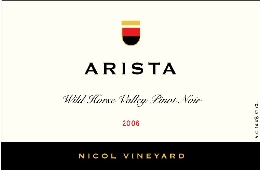
So tonight I opened (what I recall being) a $35 bottle Nicol Vineyard 2006 Arista Pinot Noir. The Nicol Vineyard is actually in the Napa Valley. Arista has its own vineyards and buys some fruit as well, or did.
Arista is not a huge producer and made only 164 cases of this wine.
The Pinot had a huge nose and beautiful structure though it is still a little big and out of balance on the finish. There is a cinnamon or spice characteristic to their wines that I really likely. It’s a bit of a smokey wine. This wine spent 11 months in French Oak .. so it has a big finish.
Arista has only been around since 2002 and is finding its niche. I have a couple more bottles in the basement, including some from estate grown fruit. I’m anxious to try those in a few more months or another year or two to see how they age. This is good Pinot Noir.
Send comment or questions to: hewitthoward@gmail.com
My latest newspaper column is up on Grape Sense. You can go back and read others and see the latest on that separate blog. I release a new column every other week, but they are published at different times by the eight newspapers running it.
In that column I note the newspapers have a combined circulation in excess of 90,000. That number surprised me a bit. But it is nice to reach that many potential readers. I need to go back and work on a few other newspapers about running the column.
I’ve been doing this a year now and wrote the column – a bit self-serving, I know – about one year of wine writing.
When I logged in to write this short post, I noticed this is my 200th blog post since starting the wine blog!
Thanks for reading!
Send comment or questions to: hewitthoward@gmail.com
Chile and Pinot Noir is a pairing you don’t often see in the same sentence. But new world Pinot Noir is coming along nicely in some regions.
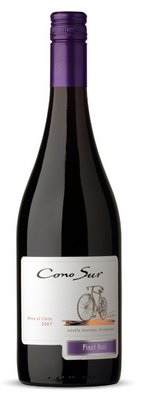
I tried an Argentinian Pinot recently and was unimpressed. But I must say tonight’s Chilean Cono Sur 2008 Pinot was pretty decent $11 wine. The wine comes from Chile’s premier wine growing region the Colchagua Valley in western Chile.
The winery uses “green” friendly growing techniques and makes its wine from 100 percent organically grown grapes.
This particular wine had a taste of berries on the palate that was initially unpleasant but really improved as the wine opened up. This is an inexpensive Pinot that needs chilled and needs opened before drinking.
It has a nice Pinot “stink” and – shocker – it tastes like Pinot Noir! The acidity improved considerably, as you would expect, with that extra time open.
This is a pretty good inexpensive Pinot Noir. Give Chilean wines a try because they tend to be great, great values.
The Cono Sur is 14 percent alcohol and anywhere from $11 to $15. I paid $10.99 at Cork and Cracker in Indianapolis.
I like the sophistication of Oregon and California Pinot – but the price is considerably higher. For under $15, this Chilean Pinot is pretty good juice.
Send comment or questions to: hewitthoward@gmail.com
I’ve always had a bit of a love/hate relationship with Chianti. Actually not just Chianti, but most red Italian wines.
I love the taste characteristics of the Sangiovese grape – the black currant, dark fruit, and a certain earthiness and acidity! But it seems like most of the under $15 Chianti is not well made. I find one good Chianti for every four or five so-so or awful ones.
I have used space here and ink on newsprint in my newspaper column to frequently knock “supermarket” wines. For years I had avoided Ruffino Chianti. If its sold in supermarkets, it can’t be very good – right?
And geeeeez, it used to have that cheesy basket thing on the bottle!
Well, (ever so humble) – I was wrong. I recently received a shipment of samples from Ruffino and tonight opened the first one. This was Ruffino’s basic Chianti. It’s a $9 bottle of Italian wine.
You know what? It was pretty good! It’s a lighter flavored Chianti, for sure, but it was balanced and clearly a well-made wine. The 2008 is 75 percent Sangiovese with some Canaiolo and Colorino blended in. It has a light nose with a hint of spice.
It’s not a big wine. But it is a perfect wine for your pasta dishes and perfect for anyone that stays away from really big-flavored red wines.
Common sense has to tell you – or me – that if a wine has been around forever (like 100 years in Ruffino’s case) … if a wine is found in lots of supermarkets, that someone must be buying it. The wine must be palatable. Well, this wine was far better than palatable. I’d serve it to guests. This bottle was sent to me for review, I’d buy this Chianti in a minute.
It’s always rewarding to be surprised. I never mind being wrong about something when I find a wine that’s this enjoyable for $9.
I looked around YouTube for something on Ruffino. I found an old promotional video in Italian. But then I found this nice video about Italy and Tuscany from Ruffino. There are slides from Florence and the Chianti region. It’s beautiful!
Send comment or questions to: hewitthoward@gmail.com
 Last time there I asked for a couple of recommendations on some really big wine. She pointed me to a California Syrah, which is still on the rack, and the Four Vines 2006 Old Vine Cuvee Zinfandel.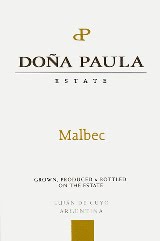


 Howard W. Hewitt