Fall – Christmas Good Time to Visit Uplands Wine Trail

Tags

, , ,

Southern Indiana’s beautiful roads in late October
 Wine country and Indiana aren’t exactly words often found in the same sentence but neither does it create an oxymoron.  Indiana has several wine trails and more than 60 wineries.

If Indiana has a wine country region, it’s southern Indiana’s Uplands Wine Trail. That doesn’t mean there aren’t other viable wineries elsewhere but several of Indiana’s best wineries are part of the Uplands.
With fall slipping away, a weekend winery visit makes for a great day. Several of the wineries are close in proximity and offer pumpkin picking, live music, or food to draw huge crowds.
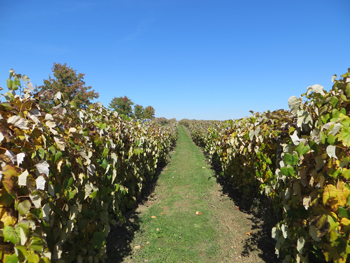
Huber Vineyards just a few weeks ago.
The biggest celebration is probably at Huber Orchard, Winery and Vineyards. Huber’s has thousands of pumpkins, live music, food, hayrides, and huge crowds every weekend in all fall. And frankly,
Huber is one of a small handful of Indiana wineries making better Indiana red wine than most Hoosiers have ever tasted in state.
Huber Vineyards set atop the hills overlooking the Ohio River near Louisville. The elevation, old glacial soils, and environment make it arguably Indiana’s best spot to grow grapes.
Just 10 miles away is Jim Pfeiffer at Turtle Run Winery.  Pfeiffer is a blendaholic by nature and takes Indiana’s sometimes eclectic grapes and makes very drinkable wines.
Check out Huber and Turtle Run’s Chambourcin red wines. You will be surprised how Pinot-like these wines can be when they’re well-made. Huber has very nice light style whites while Pfeiffer’s are uniquely tasty. And both winemakers have worked steadily to reduce the natural sweetness of Indiana grapes. If you are into Brandy, Ted Huber has been making and aging award-winning spirits for several years.

Pfeiffer
The Uplands Trail gives the individual wineries marketing power and identity. “Validity, validity, validity,” said Pfeiffer, winemaker and owner of Turtle Run Winery. “When you have event marketing and have big events people take notice.”
A shorter Uplands Wine trip would be to Bloomington to Oliver and Butler wineries. Who hasn’t visited Oliver? The winery made its name with the sweet reds and whites but the Creekbend line of Oliver wine and other bottlings are very solid choices. Try Oliver’s Chambourcin and his Syrah. Bill Oliver makes his Syrah in a lighter French style that’s fruit driven with a hint of spice. I’d challenge anyone to blind taste his Syrah and guess its origins.
Next wander into the colorful countryside to Butler winery. Jim Butler is another of Indiana’s wine pioneers. He got his start at Oliver and then branched out on his own. He owns the unique distinction of winning the initial category first place in the Indy International Wine Competition a few years back with his wonderful Dry Rose’ wine.
Butler
But the Uplands area is more than just marketing. It soon may get validity well beyond good marketing. Butler has put in years of effort to get the Uplands designated as an American Viticulture Area approved by the federal government. It gives the area a unique labeling for its style and quality of wine. It’s an achievement that wine aficionados will recognize as serious winemaking.
“We probably started four or five years ago and we’re in the home stretch,” Butler said. “I’m hoping by the end of the year we’ll have it.”
All nine Uplands wineries have good websites with directions and hours. The wine trail also plans a holiday event Nov. 15-Dec. 31. The state has two other wine trails, another through Southern Indiana known as the Indiana Wine Trail, and the Indy Wine Trail around Indianapolis.
Indiana’s Uplands Wine Trail
{Est. 2008}
{Est. 1986}
{Est. 1983}
{Est. 2003}
{Est. 1995}
{Est. 1978}
{Est. 1972}
{Est. 2001}
{Est. 2002}

Send comment or questions to: hewitthoward@gmail.com
A Great White & A Solid Value Cab

Tags

,

Two more wine reviews and I’m caught up on recent bottles for review. If you want an all-purpose white wine great with food or alone, I’ve got one for you. Or, how about an affordable Central Coast California Cabernet?

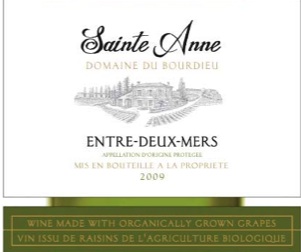
Domaine du Bourdieu Entre-Deux-Mers 2010 – This Sainte Anne white Bordeaux represents what many people will tell you – white Bordeaux is one of the world’s great value buys.

The wine is Sauvignon Blanc, Semillon, and Muscadelle. Then 10 percent of the juice sees a bit of oak. This wine stands alone with its smooth palate feel but has enough body to pair nicely with seafood.

Entre-Deux-Mers is a wonderful region just to the southwest of the city of Bordeaux.

Sainte Anne Entre-Deux-Mers White Bordeaux, these wines generally available under $20, (I bought this bottle as a package buy so don’t have SRP), Highly recommended. If you can’t find this one, try some white Bordeaux.

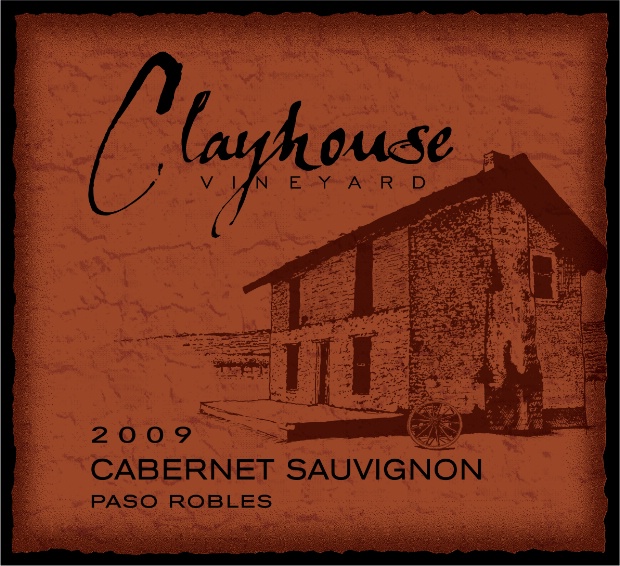
Clayhouse 2009 Cabernet Sauvignon – Clayhouse is one of the great value labels out of California’s Central Coast. You get the wonderfully bold flavors of Paso Robles for an average of $15.

This is not a smack-you-in-the-face like many California Cabs, but it has real Cab characteristics in the flavor with a smooth feel in the mouth. This wine will be a bit bigger than many Cabs at this price point.

It’s nice dry red wine with the dark fruit, some spice, and moderate tannins. It’s highly drinkable, affordable, and should be easy to find.

Clayhouse 2009 Cabernet Sauvignon, SRP $15, Trade Sample, Recommended.

Send comment or questions to: hewitthoward@gmail.com
Merlot and Pinot Noir Knock It Out of the Park!

Tags

, , ,

The two wines I’m catching up on tonight were big surprises for me for different reasons. One was a wine I generally find “blah” (that’s a technical term) and the other was a big surprise from an unlikely location.

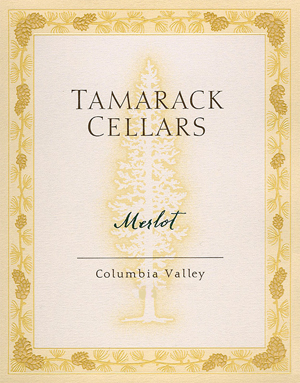
Tamarack Cellars 2008 Merlot – I don’t dislike Merlot nearly as much as I often find it uneven, uninteresting, and over ripe.

I was picking wines for a big dinner at work and tasted the Tamarack and was blown away by the dark fruit, chocolate, and spice of the Washington state wine. It’s 90 percent Merlot with a splash of Cabernet and Cab Franc sourced from the Columbia Valley.

This Merlot had structure and secondary flavors of cocoa powder, maybe a slight hint of cinammon or one of those pumpkin pie spices. It was just wonderful with the steak we had at the dinner.

Wine Enthusiast liked this wine too, awarding it 92 points. Robert Parker at Wine Advocate gave the juice an 88, a bit down from Enthuisast obviously but still a good score.

I’d recommend this wine to anyone wanting a nice wine with a beef dish. It has a richness and structure that an awful lot of Merlot lacks.

This was simply one of the best U.S. Merlots I’ve tasted in a long, long time. I did buy this wine in Indiana.

Tamarack Cellars 2008 Merlot, $19-$26, Highly Recommended.

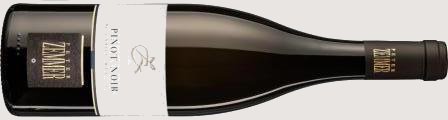
Peter Zemmer Alto Ridge Pinot Noir – Pinot from Italy! Seriously! Sure, I know the Italians grow some Pinot Noir and I’ve tasted just a few but this one was darn nice wine.

This area is up near Austria in Italy and clearly takes advantage of the higher altitude to produce very enjoyable Pinot. It was fairly light on the palate but had true Pinot characteristics for my palate. It has soft cherry and some floral hints on the nose and taste. It also had that silky quality I love in Pinot Noir!

Peter Zemmer Alto Ridge Pinot Noir, Around $20, Recommended.

Send comment or questions to: hewitthoward@gmail.com
An Easy-Drinking Cab and Chianti Red Wine

Tags

, ,

Being way behind on wine mentions/reviews, time to catch up.

Here are some thoughts on really easy to find California Cabernet and Italian Chianti. I’d argue these are two wines you should always have on hand. A nice, easy-to-drink Cab for beef and a nice Chianti for pasta of fava beans in case Anthony Hopkins is a dinner guest!

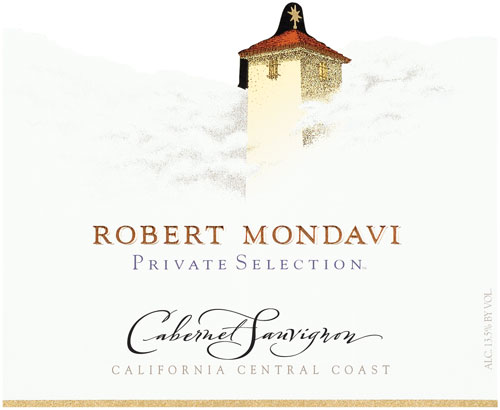
Robert Mondavi Central Coast 2010 Cabernet Sauvignon – This wine is available, most probably, in your supermarket. Frankly, for $11 or less, you can do much worse. This wine does not have strong Cabernet characteristics but its quite drinkable. And after all, isn’t that always the real test?

The wine is 88% Cabernet Sauvignon, 5% Syrah, 3% Merlot, 2% Petit Verdot, 1% Malbec and 1% Cabernet Franc from California’s Central Coast. It’s soft, It;s red. It tastes pretty good.

I drank this wine with some mildy spicy pasta and then with some chocolate and found it enjoyable. I love wines like this because they are easy to find and easy to drink.

Mondavi has repackaged this line with a focus on Central Coast fruit. The Mondavi Private Selection remains one of the best values for drinkability in the supermarket and elsewhere.

Robert Mondavi Central Coast 2010 Cabernet Sauvignon- SRP $11, (trade sample), Recomended. Try this wine for $9-$11. It works at that price point.

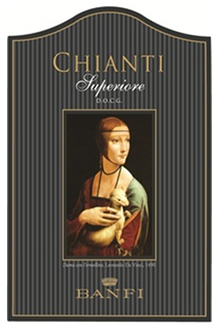
Banfi 2010 Chianti Superiore –  Wine Spectator gave this wine an 87 and that’s about right. This is much like the Mondavi above. Is it a true representative of great Sangiovese, well – not quite. Is it drinkable and enjoyable – well, yes it is!

It has some cherry and a little astringency but a drinkable bottle of wine. If you have some pasta with tomato sauce or tomato based it will work well.

This wine can be found really cheap and in lots of liquor stores and wine shops. There is nothing special about it other than its simple drinkablility without any negatives. For the price, go out and buy it.

Banfi 2010 Chianti Superiore – SRP $11, (trade sample), Recommended Look around and you might find this bottle at $9-$10.

 
Send comment or questions to: hewitthoward@gmail.com
Michael Ruhlman on Writing, his Career

Tags

Just two weeks ago noted food author and chef Michael Ruhlman visited the college where I work. He is known for his books on food and chefs. But he is also recognizable as a Food Network judge from shows like “Iron Chef” and “Next Iron Chef.”

Ruhlman was a delightful guest. He’s a very accomplished writer who breaks down the essence of cooking by techinque and ingredients – just not another recipe.

While he was on campus we sat down and I interviewed him for our campus YouTube channel. But we also covered a few food topics.

I wrote a column a couple of weeks ago with Ruhlman on cooking with wine.


Send comment or questions to: hewitthoward@gmail.com
Check Out the Photos From Chablis Trip

Tags

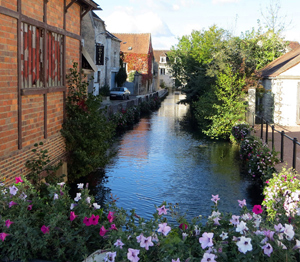
A pretty little canal in the heart of the village of Chablis

One of the fun things about trips to wine country, besides the incredible wines, fabulous foods and the royal treatment, is a chance to shoot photos.

I did a little (not much) photography off and on in my newspaper career. But when I took my current position in 2004, I had to step up my photo game.

I’m still a photo novice of sorts but have gotten much better. I have carried heavy and expensive equipment on previous trips that’s not much fun for travel. So when I was in Bordeaux and noticed a fellow journalist/photographer using a higher-end point-and-shoot camera, I asked a lot of questions.

The result is I went out and bought a 12 megapixel, 20 times zoom, image stabilization camera for under $300.

The album attached is the result and I’m pretty pleased. Check out my shots from Chablis.

Send comment or questions to: hewitthoward@gmail.com
La Chablisienne Breaks the Mold

Tags

,

The fall colors of gold sweep the Chablis Valley

For the average consumer the idea of a negocient or wine cooperative just fogs over the moment the words are used.

And part of the haze is understandably for sub-par wines. There are exceptions around the world and perhaps one of the leading cooperatives is La Chablisienne, in business since 1923.

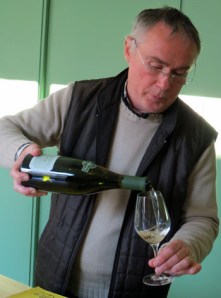
Tucki pours Chablis for us to taste

It all started back then during economic hardships. A group of winegrowers decided to partner as a way to sell their wines as a group wholesale to the wine trade. That model didn’t change much until the 1950s when the La Chablisienne leaders decided to make the wine themselves for a consistent style.

La Chablisienne was the final stop of a brief trip to Chablis. Herve’ Tucki is called an Ambassador and shared some of the organizations thoughts on winemaking and the history of the coop.

As with previous stops the discussion revolved around mineralilty and acid. And here comes a side note: One of the things that happens on these press trips is wine journalists have a certain story or angle they are pursuing. A couple of the journalists on this tour were interested in those two oft-discussed topics and it’s highly appropriate in a region like teChablis. Though, the horse did seem to be tiring by the last stop.

But each time I have the opportunity to hear winemakers in any region talk about their craft I gain knowledge if not different perspective.

“La Chablisienne loves minerality. We love acidity,” Tucki said. “We are not afraid to say that and we want to make wines that last a long time. The La Chablisienne approach to making Chablis is very classic.”

Total production runs more than 150,000 cases a year. The discussion opened on oak even before the first pour. For the record, and there is no record on this topic, generally the Petit Chablis and Chablis see no oak and are produced using stainless steel. The Premier Cru and Grand Cru wines see varying percentages of oak barrel aging – and that’s usually older oak which leaves less impression on the wine.

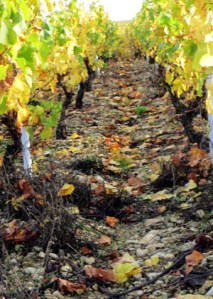
You understand ‘minerality’ if you look at vineyard floor

“Sometimes I don’t understand my colleagues,” Tucki said. “Oak is one way to make wine. I know some very good producers who only oak and sometimes that’s becausee that producer doesn’t have a good way with the oak.”

Now, if that sounds confusing in type, that’s because it probably is. The written word has no intonation particularly from someone who speaks English only as a second language. I interpreted that to clearly mean that some producers just know the old way. The current generation or younger generation of Chablis winemakers have had the benefit of college wine-making educations which have radically changed winemaking in the world world regions.

But what came through at La Chablisienne, as it did at every other stop, is that there are many styles of Chablis. Every slightly different terrior in this beautiful valley, covered in vineyard up and down steep slopes has slightly different terroir.

La Chablisenne, for example, makes two Petit Chablis, five Chablis, thirteen Premier Cru and five Grand Cru wines. Keep in mind what wine educator Erik Szablowski said about terrior. There is only one Grand Cru appelation but it has 7 distinct regions  – Bourgros, Blanchot, Les Clos, Les Preuses, and Vandesir.

French can make their terroir and wine regions confusing but when you are there, see the vineyards and taste the individual wines it all comes into focus.

These are elegant and sophisticated wines which just might be the best white wines in the world, You need to taste a Premier or Grand Cru and judge for yourself. It’s a test worthy taking!

Send comment or questions to: hewitthoward@gmail.com
Ceremony, Parade, and Wine Icon

Tags

,


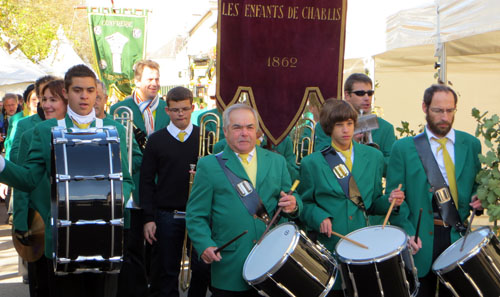
The Sunday morning Fete des Vin parade!
PARIS – Sunday was really quite an exhilarating day to the end of a very brief trip to Chablis for the 64th Fete des Vins.
A ceremonial and fun honor, an afternoon with an icon of Chablis winemaking, and more great white wine.
Right after the Chablisien ceremony
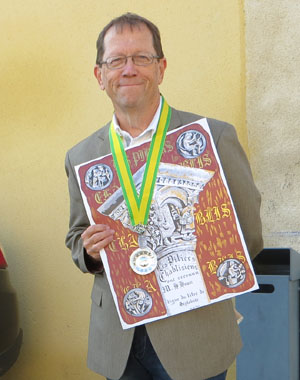
I’m Now a Pilier Chablisien
The Les Piliers Chablisiens are a group of (mostly) elder Chablis statesmen who formed a brotherhood for those who bring honor to Chablis. Now, those are my words not there’s. They induct guests and those who contribute to Chablis into their organization with a fun and ceremonious ritual that was really an honor.
Now they do induct quite a few but considering size and scope, there aren’t many of we Piliers out there. At an incredible Saturday night banquet about  20 members of the Chablis community and supporters were inducted into the brotherhood. On Sunday morning following the Fete des Vin parade, a crowd gathered near the Chablis tourist office and one of the small village’s main gathering points.
It’s hard to describe and maybe I can find a video somewhere. But after political speeches by local mayors and a regional governor, my three fellow journalists and I joined the brotherhood. We were brought to the stage where one of the members read a prepared short bio about our wine writing.
Then we were given a rather large chalice of Chablis wine. The members break into a traditional French folk song and we had to chug the wine to be inducted. And, the group repeats the same “la, la, la’ until the last member of the group empty the vessel.
I’m hoping to at least get a few photos. We were presented a certificate showing our membership and a lanyard with a small cup attached (see photo) that is a sign of honor seen throughout Chablis as a member of the Chablisiens.
Having watched it Saturday night, I’ll just say it was great fun and way more cool than I anticipated going through the ceremony.
Visiting the Fete.
I hit up quite a few of the booths Saturday and made it to just a few on Sunday. The Fete pales in comparison to the Bordeaux Fete le Vin I attended in July but they are  totally different animals. The Bordeaux event had all the feel of an international tourist attraction while Chablis’ Fete des Vins felt more like a local celebration.

I listed several wineries yesterday worth looking for at your better wineshops. I visited three Sunday and could only recommend one.

Alain Geoffroy Chablis – This Chablis producer had very elegant wines but definitely in a lighter style than some. I found the wines very enjoyable. Some of the Chablis I tasted, including two other Sunday stops at the Fete’, went too far to the lighter side for my palate.

An Afternoon with Chablis Icon Billaud
It’s fair to say almost every wine region in the world has its iconic producers. Few would argue or contest Bernard Billaud of Billaud-Simon is a Chablis household name.
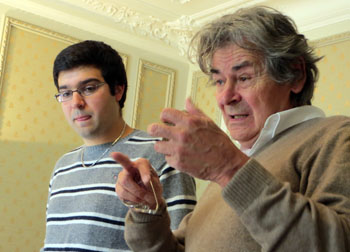
Bernard Billaud with his young assistant, and translator, Nicolas
Bernard is everything a stereotype about a French winemaker should be. From his disheveled look, genuine smile and enthusiasm, to his almost angry definitions of what a Chablis wine should be – Billaud was extremely entertaining and educating.
I lost count but we tasted around 10 wines. I will write more about that in a future post or column. But his wines have been widely distributed in the U.S. for more than 20 years and were clearly the best of the Chablis I tasted over this long weekend.
As Bernard, and his young assistant Nicholas, weathered inane questions about oak and particularly acidity, Billaud’s passion erupted. “Chablis wines are acidic wines,” he said. “Chabis wine is a dry white wine from a single vineyard.”
But much more than acid, Chablis wines are about minerality and a sense of place, he insisted. It is really a cultural and unique wine experience to see these elder statesmen of such an iconic wine region as Chablis take to the pulpit and preach some fire and brimstone about their life’s work.
I’ll write more soon about his specific wines. But if you want to enjoy some of the, arguably to an extent, world’s best white wines just try the Billaud-Simon label from any of the four appellations.
Wine Cooperative Le Chabisiennes
Our final stop of the trip was at one of the world’s more successful cooperatives, Le Chabisienne. The cooperative has 300 members and makes a Petit Chablis, a few Chablis, and a Chablis Premier Cru from each of the different appellation regions, as well as the top-of-the-line Grand Cru.
Herve’ Tucki, Chablisienne “Ambassador” poured a Petit, two Chablis, a Premier and Grand Cru. These cooperatives don’t work in a lot of country’s wine regions but this one has history on its side. Often in the wine world, cooperatives are considered second class wine or producers who can’t sell their grapes or juice any where else but not in Chablis.
Le Chablisienne makes wines which are honored along side the region’s best known names like Billaud-Simon and others.
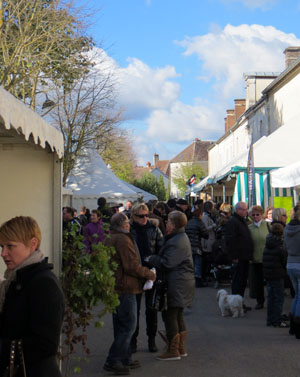
Sunday at Chablis Fete des Vin
And other notes …
Our day ended with a long taxi ride back to Paris. I’m staying at a very nice Hilton at de Gaulle airport. Two of the four members of my group, scheduled to fly directly to the east coast have already had their flights canceled because of the approaching hurricane.. My return trip is Paris to Detroit via Air France. As of this writing, my northern path seems clear and my flight is still on as of Sunday night.
I often question myself before taking these press junkets, but again learned so much about a region that I would never have learned in any other way.
I’m not a Chardonnay fan by nature.. But in Billaud’s words, if Chablis doesn’t have great minerality and sense of place, then you’re just making Chardonnay. 
That was good enough for me.

Send comment or questions to: hewitthoward@gmail.com

Learning Chablis’ Differences

Tags

, , , , , ,


Very chilly but spectacular view of Chablis from the vineyards

Who stands atop a hill with strong winds and 36 degree weather talking about wine? I would be guilty as charged.

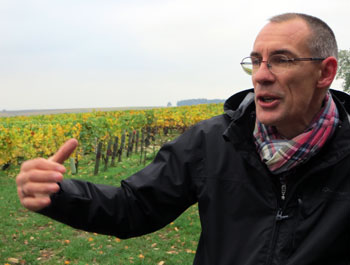
Szablowksi talking terroir atop the hill
But it’s not a normal occasion to be standing on top of a hill overlooking Chablis, France, with one of the area’s top educators. Our small press contingent had the opportunity this morning to spend time with Eric Szablowski, one of Burgundy’s leading wine experts.
It was darn cold but fascinating to hear why Chablis is so special and different. At several times this morning the group discussion followed a similar pattern. The world knows Chablis as a fresh, clean wine with good minerality – but they can also be quite different.
Erik took us into the vineyards and showed us the incredible slopes on the hills around Chablis and nearby villages. He explained the effect of the clay and limestone soils which effect the vineyards and therefore the wines.
Chablis is not a large area with 350-400 wine growers and just more than 100 producers of any significant amounts of wine. Additionally, these produces export approximately 70-80 percent of all the wines they make.
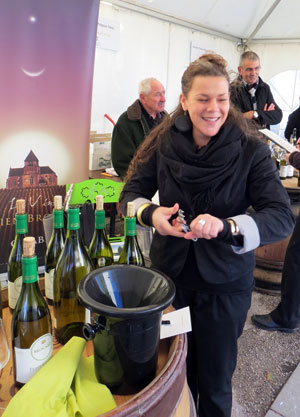
Tasting at the Fete des Vins
But to understand how one wine with the standard characteristics can vary to the next Erik explained the terroir. Take the Grand Cru vineyard, for instance. There is just one Grand Cru but there are seven different sub climates within that vineyard area with its slopes, soils, and exposure to the sun. “Eighty percent of the quality of the wine is determined in the vineyard and the other 20 percent by the winemaker,” he offered.
We followed up the chill walk around two sections of Chablis vineyards by tasting the 2012 ChablisWine Award winners. We tasted 10 different wines which won mostly gold, and a few silver, medals in the recent competition. The tasting showed the differences slight and significant the Chardonnay grape can produce in this diverse terroir.
I hope to add notes on most of the 10 wines later. I did take notes to share because most are available in the U.S. My two favorites were Damien and Romain Bouchard’s Premier Cru Montee’ de Tonnerre and Domaine Drouhin’s Vaudon Chablis Grand Cru.
The event we’re here to enjoy is the Chablis Fete des Vins, or festival of wine. There are more than 50 producers pouring their wines, food, and entertainment.
Our group translator Isabell Terrillon accompanied me to a number of booths she recommened for visits. Here are a few of my favorites. All of the ones listed here have at least some distribution in the U.S.
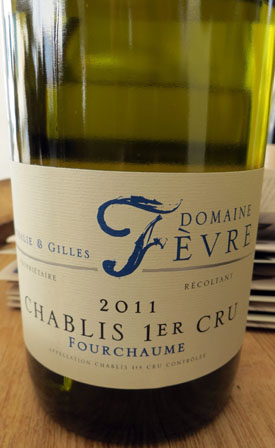
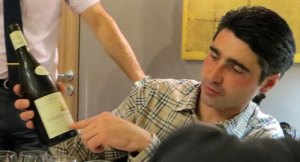
Domaine Fevre (Nathtalie and Giles) – I tasted through most of the Chablis with Nathalie who speaks great English. I loved the consistency of her wines with or without hints of old oak. Many of the labels had good bottles but some not quite at the same standard.  Her wines were age worthy but showed quite nice as young wines.
Domaine Chantemerle Boudin Pere & Fils – A limited selection of wines but also available in the U.S. I loved his two Premier Cru wines at very affordable prices. With a very old-world label they represent the second tier (Premier) well at prices in France of under 20E.
Vins Fins de Chablis (Isabelle et Denis Pommier) – Again very consistent across the four major appelations of Petit Chablis, Chablis, Premier and Grand Cru. Isabelle took time to answer questions and talk about the wines. Another very affordable label even once you add the importing costs and distribution markups for top quality Chablis.
Jean-Marc Brocard– This was my first stop of the festival and one of the best. The Brocard name is well known not just in Chablis but around the world. Consistently in elegance and style, the wines were consistently well balanced with great minerality, finesse in winemaking, and reasonably priced. I bought a Premier Cru to bring home.
Domaine des Marronniers (Bernard Legland) – A producers of very stylish wines with understated fruit and that nice acidic finish you expect from Chablis. Bernard poured the wines at the booth and talked about the vinification (through Isabelle’s able translation.)
Pascal Bouchard – A great name producing great wines. I like the twist of his sons, who won one of the Chabis Commissions 2012 awards for their Premier Cru Montee de Tonnere  label. Romain Brocard poured three different Chablis which I found enjoyable across the board. The Montee de Tonnere was one of the best wines I tasted all day.
I did taste at a couple of other booths but found the lines inconsistent or not to my liking.

Send comment or questions to: hewitthoward@gmail.com
First Taste Sets Bar High

Tags

, , ,

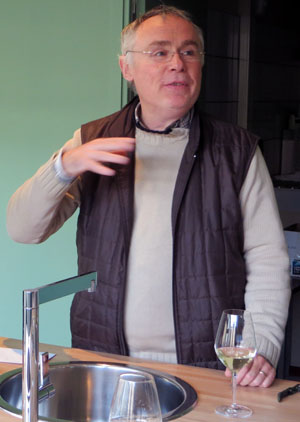
Jean Francois Bordet talking about his Grand Cru Chabis
A great French tradition – the cheese course before dessert

AUXERRE, France -Dinner at a nice French restaurant, all four levels of Chablis wine, and an influential and charming host make all the woes of travel melt away.

The weekend in Chablis was kicked off with a welcome dinner for me and my three fellow U.S. wine writers. Jean Francois Bordet, Domaine Seguinot-Bordet, and President of the Chablis Commssion of Burgundy was our host.

Let’s get the very basics out of the way for most. Chablis comes from four main classifications – Petit Chablis, Chablis, Chablis Premier Cru, and Grand Cru. Bordet was just 21 when he took over his grandfather’s Domaine in the late 90s.

He shared the history of his family’s wines, the changes he has made since taking over and of course poured his wines. Dinner started with a delightful warm carrot soup in a shot glass, nice salad with toasted sweet potato chips and fava beans, and I had the pork neck in Burgundian sauce. Dessert was a this great little chocolate mess.
.
Bordet’s wines ranged with the light and mineral driven Petit Chablis to the elegant Grand Cru. Many of the Grand Cru wines do see some time in oak. Bordet uses large barrels and never new oak. The perception is usually most of Chablis is completely unoaked Chardonnay.

I probably should make a disclaimer as I start writing about this weekend. I have certainly had some Chablis through the years but it is one of those areas where I’m really trying to absorb a lot on this trip. My knowledge of the region and wines is minimal. That’s why I found this trip so exicting.

Bordet also addressed the ongoing issue, particularly for French wine makers, of educating the consumer. Even with just seven Grand Cru vineyards, there are differences. I hope to grasp a better understand today (Saturday) when we being our day walking the vineyards near the village of Chablis.

We will be tasting Chablis award-winning wines this morning then spending our afternoon at the Fete des Vins wine festival with more than 50 wineries pouring their Chablis.

Tonight is a large and prestigious banquet of the Chablis wine growers association. The press contingent has been invited. These affairs come with quite a reputation that I’m anxious to witness first hand.

I’ll be doing updates throughout the day on Facebook and Twitter.

Send comment or questions to: hewitthoard@gmail.com