Hoosiers, Buckeyes – Different Palates?

MINERAL SPRINGS, OH. – Or, YOUNGSTOWN – I travel for business, the one that pays the bills, and have always enjoyed throwing up a restaurant review. (was that a pun intended? – we’ll see)

What are the odds you’ll find yourself in Youngstown, Oh., along I-80 or this weekend in Wooster, OH., not far off I-71? The answer of course is you just never know!

photo (11)The Fifth Season had so-so TripAdvisor ratings but a hearty endorsement as quite nice with “different things” on the menu from the hotel staff where I was staying.

It turns out they are as much a catering business as a restaurant but the place was packed but they had room in the bar. I ordered a fried shrimp appetizer that was borderline okay but nothing fresh nor spectacular. The cocktail sauce was largely catsup. The nice salad tasted very fresh with a yummy homemade balsamic dressing. I should have stopped there.

A tough, clearly frozen, chicken breast floating in a sea of oil.

A tough, clearly frozen, chicken breast floating in a sea of oil.

I ordered this roasted chicken dish set up over some spinach and tomatos. Unfortunately, the chef’s idea of fancy was smothering the the chicken with a lot of oil and way too much garlic. Then there was this tacky round of gouda cheese on top. I’ve had much better food in the college dining hall where I work.

Before dinner I sampled a red blend I was not familiar with that was decent enough. The wine list was sadly inept for a place that fancies itself fine dining even in the industrial Youngstown suburbs. The Cryptic Red Blend was a Zin-Cab combo that was quite drinkable. It had not depth and little finish but nice fruit and went down just fine. I found it online for $14 retail. I think I paid $8 for a glass.

The bill, including tip, was $32.29 so you get what you pay for in most cases. The deep fried shrimp you could make at home, the salad was great, the entree was an embarrassment.

Now, the headline on this post reflects the fact I’ve had two less-than-memorable dining experiences in Youngstown. Four or five years ago my traveling companion and I visited Marino’s Italian Restaurant not far from the same hotel. The staff highly recommended it this past weekend before I suggested I had a previous bad experience. The pasta on our visit was over-cooked, the sauce tasted like watered down bottled stuff off the grocery shelf, and the top of the wine selection was Ecco Domani.

Two very nice ladies at a wonderful little chocolate shop also sang the praises of both restaurants.

What is it with the Buckeye palate? So, as vaguely referenced above, I’m back to Ohio later this week with a much more promising restaurant visit as part of business. Is it bad Buckeye taste? Hoosier snobbery? Or, bad luck?

My fingers are crossed I’m just a snob and have a great meal.

Summer’s Last Gasp Wine Choices

Tags

, , , , ,

Leaves are turning yellow and they’re soon to be glorious red and brown so can the frost on the pumpkin be far behind?

Grape Sense LogoIt’s a gloriously beautiful time in vineyards across the Midwest as grape harvest has been underway for 3-4 weeks with another week or two likely in some areas.
But don’t leave summer behind just yet. There will be mild and warm days in October perfect to clear the shelves of those summer wines. Here are a few easy-to-find lighter style white and Rosé wines I’ve enjoyed this summer.

3134Myt5uUL._UX480_CR0,-5,480,490_Domaine Ott Rosé – The 2011 Les Domaniers was still on the shelves early this summer but the 2012 shouldn’t be hard to find. Wonderful floral scents with a well-rounded mouth feel that will hold up to BBQ and bigger meals or sip fine all alone. It’s a classic blend of Grenache, Cinsault, and Syrah. ($19)

Whispering Angel Rosé – My absolute favorite Rosé from Château d’Esclans of Provence represents Southern France’s best effort at pink wine. The 2012 is dry, light, and still delivers full flavor. It’s fabulous Rosé for the price point. ($16-$23)

david-hill-logoDavid Hill 2011 Estate Pinot Gris – This has bright and pronounced acidity with aromas of stone fruit. Many of these white wines don’t offer much of a finish but David Hill delivers. Try this with some grill shrimp on the BBQ. It’s great white wine from Oregon’s Willamette Valley. ($18, Trade Sample)

Franciscan 2012 Equilibrium – Red blends are all the rage so why not a good California white blend. Franciscan makes great wines and reasonable prices. The blend is a mix of Sauvignon Blanc, Chardonnay, and Muscat. It’s a well-balanced glass of wine with a hit of peach. It would be a perfect match to a salad or spicy food. ($23, Trade Sample)

domaine-virgile-joly-languedoc-le-joly-blanc-languedoc-roussillon-france-10504697Joly Blanc 2011 – Okay, it’s pretty cool to say you have a friend, maybe acquaintance, who is a French winemaker. Virgile Joly’s Joly Blanc – Grenache Blanc – is consistently one of the best whites I taste from the land of fries and crepes. The wine is Grenache Blanc with a hint of Rousanne delivering great aromas and a hint of peach. It is delightful with grilled fish or lighter meats. ($13-$15)

Four Graces Pinot Blanc – This Willamette Valley winery makes small batches and highly-stylized wines. The Pinot Blanc is quite different than the valley’s Pinot Gris wines. This is a light bodied wine with hints of honey, banana, and perhaps apricot. It’s a great white for warm weather meals. (SRP, $24. I bought it in an Indiana shop for $16)

Matua 2011 Sauvignon Blanc – It’s impossible to write about warm weather wines and not have at least one Sauvignon Blanc on the list. If you like your whites with big citrus, big acid, and a crisp refreshing finish, you’ll love the Matua. This comes from New Zealand’s Marlborough region, known for its Sauvignon Blanc and Pinot Noir. ($16)


Buck Creek’s Older Vines Deliver

Tags

, , ,

JUST SOUTH OF INDY – Indiana now has nearly 70 wineries and I’ve visited nearly 25 of them. Three stops this year yielded a 1-2 record (in sports jargon, at least).

My first two 2013 stops yielded mediocre to undrinkable wine. I struggle to write about those out of a sense of fairness to someone’s livelihood but what value would anything I write be if I’m just a cheerleader?

So it was with trepidation I finally stopped at Buck Creek Winery visible on I-74, just south of Indianapolis. Let’s just say my faith was restored!

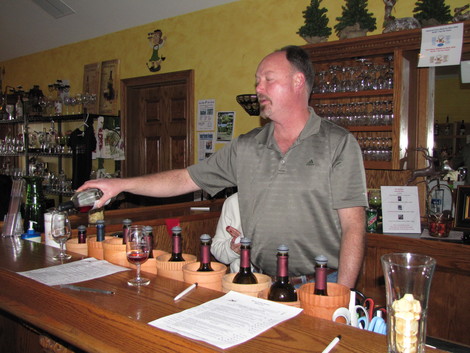
Jeff Durm pours in his tasting room. Yahoo.com Photo

Jeff Durm pours in his tasting room. Yahoo.com Photo

Jeff Durm retired from the Marion County Sheriff’s Department and opened the winery in 2006. But more importantly, bought the property and established the vineyard in 1991. You can see vines zipping along I-74.

Old vines make better wine – it’s pretty simple. But you still have to know what you’re doing. Jeff was a home winemaker then shadowed veteran Dr. Charles Thomas at Chateau Thomas to hone his skills.

He’s doing something right. The wines were quite good – and some were as good as any produced in the state.

I tasted the Seyval Blanc ($12.95), not to my taste but well made and estate grown. The Traminette or “Forget Me Not” ($12.15) was really solid if a bit on the sweeter side.

The reds are what really got my attention. Durm’s “Amore” or 100 percent Chambourcin was silky smooth, bigger fruit than some Indiana versions with a lighter finish. It was darn good wine at $14.95.

Durm’s William Loyd Reserve ($14.95) is a bigger version of the basic Chambourcin with two Noire grapes added in. It didn’t have the balance of the first wine but certainly had a more complex flavor.

Jeff’s Merlot sourced from California’s Mayacamas region of Napa Valley was outstanding. Dark fruit, great tannin structure from time in French and American barrels and a really good buy at $17.95.

Buck Creek has 29 wines on their tasting sheet.

Buck Creek has 29 wines on their tasting sheet.

But, shaking my head while I write this, the best of an extensive wine list was a Pinot Noir. Yes, Pinot! But wait – it gets more head shaking than that. The grapes were grown near Sunman/Batesville Indiana area. It was light in a Burgundian/Oregon style. It was 100 percent correct for the Pinot grape. It was aged one year in small French and American oak barrels. It sells for $15.95. I’m still shaking my head. I brought a bottle home to try in a few days to see if my initial impression holds up. I’ll update here.

The small but beautiful tasting room and knowledgable staff help make Buck Creek a really good stop. Jeff also makes a full line of sweet and fruit wines. He entered nearly 20 wines in the 2013 Indy International Wine Competition and won medals for all but one.

And one more note, I’ll be going back to visit with Jeff and tell more of his story. But before I left he wanted me to taste a barrel sample. Joe and his son are making a traditional Bordeaux blend of Cab Franc, Cab Sauv, Petit Sirah (from Lodi), and Merlot (Mayacamas). It was stunning. I was shocked. The grapes were from the 2010 harvest and have spent 18 months in new French oak. He only has one barrel of the wine, but I can’t wait to taste it again.

Huber Wins Top Indy Competition Award

Tags

, , , ,

Indiana is on a roll.

For the second straight year an Indiana wine won top honors at the prestigious 22nd Annual Indy International Wine Competition held in early August at Purdue University.

Grape Sense LogoHuber’s Orchard, Winery and Vineyards took the honor for the competition’s top wine with its Vignoles. A year ago River City Winery won the prize also with Vignoles.

“I think Vignoles really hits a consumer sweet spot,” Ted Huber said in explaining the second straight Vignoles win. “Consumers want nice fruit but more and more without the sweetness.”

The wine comes in with a modest .73 percent residual sugar and a light 12 percent alcohol. The Vignoles is grown on the Huber 80-acre vineyard. Vignoles is a French hybrid grape that has been found to grow well in the Midwest.

Ted Huber pouring in his Starlight, IN. tasting room.

Ted Huber pouring in his Starlight, IN. tasting room.

Characteristically, the wine is semi-dry with low sugar and tastes of pineapple, honey and melon. On my palate it was the honey and a maybe a Honey Dew melon flavor that dominated the wine. Some wine drinkers not familiar with Vignoles might compare it to a Gewürztraminer. It has a bit of a floral characteristic on the nose but doesn’t overpower the wine. The wine can have an odd banana-like flavor that is, fortunately, missing from Huber’s wine.

“It’s always very well-received in our tasting room,” Huber says. “People are bashful about trying a semi-dry wine but pleased once they do. The tropical fruit on the palate makes it approachable. There’s nothing else quite like it. It really holds its own.”

Success is nothing new to Huber’s 80,000 case operation and tourist destination. “I think we’ve won something like 20 Governor’s Cups,” Huber said. The Indy International presents the Cup to the Hoosier winery with the most medals each year.

Huber's were harvesting Traminette Monday.

Huber’s were harvesting Traminette Monday.

This year Huber won winemaker of the year, given to the winery with the most gold medals. They also won the Eagle Award for the Best Rose Wine, Huber’s Catawba Rose.

Don’t dismiss the Indy International as just any competition. The organizers bill the competition as ‘the largest scientifically organized and independent wine competition in the United States. Judges come from across the county and all wines are tasted blind. This year more than 2,500 wines were entered from 35 states and 15 countries.

“It all starts with agriculture – growing top quality grapes lead to award winning wines,” Huber said. “Southern Indiana has proven this many times with our ability to produce world class wines.”

Hubers won double gold, the highest honor before the top wines are chosen, for Vignoles, Starlight White, Chambourcin, and Raspberry wines. They won gold medals for six other wines, silver for nine wines.

Several Michigan and Illinois wineries also took home medals. See Indy International for full results.

Huber’s Vignoles ($14.99) represents a movement among several Indiana winemakers to reduce residual sugar while maintaining the fresh fruit qualities of their wines. The Vignoles is an outstanding summer sipper but would also be good with creamy cheeses or salty meats like prosciutto.

Morning Sun Lights Up Huber Vineyard

Tags

,

Huber-VineyardMy second day at Huber’s Winery, Starlight, IN., was mostly a quick stop Tuesday morning. I did take about 45-60 minutes to wander the vineyards with the beautiful morning sunshine.

The photos speak for themselves – like the one above. Huber’s has beautiful grounds, and stunning vineyards. The morning sun just made the images a bit better.

Check out Tuesday’s photos. Read yesterday’s full post with more photos: In Vineyard at Harvest is an Education.

In Vineyard at Harvest is an Education

Tags

, , , ,

Worker framed

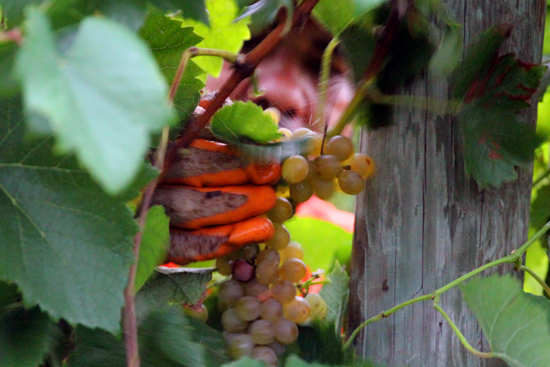
A harvest worker reaches through the thick vines to grab this bunch of Indiana Traminette.

STARLIGHT, IN. – The Monday overcast morning wasn’t necessarily the idyllic setting many wine enthusiasts vision for fall harvest. There is this romantic notion of Napa-like sunny skies, smiles and the colors of fall and wine grapes.

All of that holds true, to an extent, in Southern Indiana but a day in the vineyard during harvest quickly brings the realization that harvest is hard work. It’s hectic, its difficult, and it’s rushed – because it has to be to make fine wine.

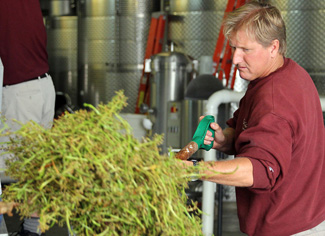
Ted Huber scooping out stems.

Ted Huber scooping out stems.

Ted Huber, Indiana’s largest vineyard owner, was kind enough to let me hang out today. I shot a ton of photos. Here is the album of more than 30 shots.

I’ve been telling people for a long time that you learn about great wine in the vineyard and not the winery. And it couldn’t possibly be more true than walk the vineyard during harvest then watch the fruit being delivered to the production facility.

All of the workers, along with Ted, were great  explaining the process and what they do during this incredibly busy time of the year.

I’m headed back up the hill to Huber’s Tuesday morning. This will be a shorter visit but they’re probably doing some bottling – something I’d like to see. Maybe buy some peaches or something!

Two Days in the Vineyard Monday, Tuesday

Tags

,

I work at a small college and the blog really suffers when we hit a busy time of the year. Obviously, the start of the year is one of those times. So it’s back at looking ahead a bit.

I’m headed to Southern Indiana the first of the week to spend time in the vineyards and wineries at Huber’s and Turtle Run. Mainly, I’m going to be doing lots of photos. But I’m sure there will be some Tweets and Facebook posts – along with some albums up on the blog.

There will certainly be a story, video, or something more. I’ve never spent a day at winery during harvest season and I’m pretty pumped about it. Hope you check in.

Regulars might notice the page link at the top about the Willamette Valley. I’m putting together a trip for anyone interested and will open registration in early October. It will be a very boutique experience with supurb accomodations, meals, and customized winery visits.

I have

Odd Couple: Fruit Wines, Food

Tags

, , ,

Michigan has long been known for its apples, cherries, blueberries and more. Indiana has raspberries, blackberries, and peaches, and more. Winemakers have been turning those fruits to wines for decades.

While fruit wine often gets the cold shoulder from snooty wine drinkers, those wines remain some of the best sellers throughout the Midwest.

Grape Sense LogoBut what do you do for dinner if your wine rack only has fruit wine choices? It’s just a matter of experimentation and perhaps a little direction from others.

“A lot of people just like sweet wines,” said Kim Doty, French Lick Winery. Many people like it for dessert. There is this mystique that you have to drink dry wines but many people like sweet … people are going to drink what they like.”

And if you like sweet wines just use a dose of logic – like pairing a cranberry wine with poultry.

Another classic pairing is raspberry wine with just about anything chocolate. The sweetness level of the wine will set the bar for sweet, semi-sweet, or a robust dark chocolate dessert. Of course raspberry wine makes a great reduction to use with chocolate desserts, cheesecake and other sweets.

Generally, wine drinkers will think of a sweeter Riesling or Gewürztraminer for spicy Asian food. Why not try a peach wine with a spicy pairing? You might be surprised how well it complements big strong flavors. You can always fall back to grape wines and pair a semi-sweet, Midwestern Traminette.

Huber Winery, with Indiana’s biggest vineyard and acres more of fruit and vegetables, makes Peach, Strawberry, Apple, and Blackberry wines.

Dana Huber

Dana Huber

“We partner one of our semi-sweet sparkling wines with a peach and a graham cracker as an appetizer,” said Dana Huber, Huber Winery, Starlight, In., “But obviously people just enjoy them as a perfect glass of wine independent as dessert in a glass. Certainly brownies or cheesecake can be a great match as far as sweet wines.”

Another wonderful pairing is just about any fruit wine with a salad. It’s simple, just think of your ingredients and if you’d add the fresh fruit to the salad or not. Add the fruit wine as a complement instead of the fresh berries or fruit.

Wine has always been a staple in most kitchens in reductions and traditional food pairings,

“We’ve had some customers marinate steaks in our blackberry wine which it gives it a really nice tenderness and a little sweetness on it,” Huber said. “The sweet wines are definitely something home cooks can use in their recipes.”

Another great fruit-based wine is infusions. An infusion usually is a wine infused with a complementary brandy. “You can take an infusion, and replace some of the water in a recipe and infuse your brownie bites. They’re really yummy and it’s a good addition.”

Doty’s winery produces an award-winning cherry wine that’s great with desserts. “One of the things with the cherry we recommend is to try it with goat cheese,” she said. “It sounds weird, but it’s really a great match.”

Wine Consumers Give Indiana an F

Tags

, ,

Anyone who has tried to buy wine at a winery, take a special bottle to a restaurant or buy wine on a Sunday knows Indiana’s laws are confusing and restrictive.

Grape Sense LogoNeighboring states aren’t much better off. Indiana and Kentucky prevent direct winery to consumer shipping while Illinois, Michigan, and Ohio allow it. All four of those states allow Sunday sales while Indiana does not. The American Wine Consumer Coalition, Washington D.C. issued a report and grade for all 50 states. It’s called Consuming Concerns: The 2013 State-by-State Report Card on Consumer Access to wine. The forward in the report bemoans the existence of laws ‘from the 1930s” that are still ‘in place in most states, despite a cultural, economic and commercial reality that is starkly different (today).’

David Honig, a wine writer, publisher of one of the country’s biggest online wine magazine – Palate Press – and attorney, says the laws make no sense unless viewed through the lens of distributor protection. “A wine lover can have their favorite bottled shipped to them, but only if (a) they’ve been to the vineyard or winery in person, and (b) left a copy of their Indiana Driver’s License, and (c) the winery has an Indiana shipping license, and (d) only if the winery does not have a distributor in the state,” Honig said.

Palate Press Publisher David Honig

Palate Press Publisher David Honig

“These laws don’t protect minors from their plans to set aside the usual adolescent need for instant gratification to order an expensive vintage for delivery in a week or two. Nor do they protect Hoosiers from bathtub gin or other adulterated hooch. They don’t even keep the streets, playgrounds, and schoolyards safe from Hillside Select swilling bums, hiding their $250 bottles in plain brown bags. They protect distributors, the top tier in the three-tier system, from suffering the indignity of seeing somebody enjoy a bottle of wine without getting a cut.”

By now you may have guessed, Indiana got an F and so did Kentucky. Michigan and Ohio came in with D grades while Illinois scored highest in the Midwest with a C.

The scoring standards were: winery to consumer shipping; retailer to consumer shipping; grocery store wine sales, Sunday wine sales, and bring your own bottle to restaurants laws.

Who scored near the top? Not surprisingly, California led the list followed by Missouri, Nebraska, New Hampshire, Oregon, Virginia, and the District of Columbia. Indiana is joined by 11 other states on the stinkers list including Alabama, Colorado, Delaware, Kentucky, Massachusetts, Mississippi, Oklahoma, Pennsylvania, Rhode Island, South Dakota, and Utah.

The hodgepodge of laws is largely the embarrassing work of state legislatures. In Indiana, the distributors’ lobby has controlled, or owned, our voting representatives. I’ve heard more than one distributor say there is little problem with allowing direct shipping because that is such a small portion of the wine-buying market. The hypocrisy is extraordinary even for state legislators. Write the representative in your state. The laws are ridiculous.

Consumers can buy almost anything through the mail and have it shipped to their doorstep – clothing, books, medicine, furniture, even pornography. This has nothing to do with under-age drinking – a favorite ploy of the distributors. You have to have a valid credit cart and a person 21 years of age available to sign when delivered to buy wine for direct shipping.

It’s about greed.

How Harsh for a Word of Warning?

SOMEWHERE IN SOUTHERN INDIANA – Indiana is not Napa, Willamette Valley, or even New York’s Finger Lakes when it comes to wine quality. But several of the state’s 70 wineries are making great wine. I’m equally sure there are a few I’ve not visited making good juice as well.

It’s a pleasure to tell the stories of the Uplands Wine Trail. I just did an interview Friday with Ted Huber about his winery winning top honors at the Indy International Competition.

A lovely setting, nice patio area, but the wine .... ???

A lovely setting, nice patio area, but the wine …. ???

But what to do when you visit an operation making substandard wine? It’s one thing for a wine not to be to your taste but totally another when the wine is flawed – or far beyond just flawed to poorly made and just plain awful.

I taste the sweet wines and the fruit wines and try to judge them for what they are and have found a respect for those winemakers producing such wines for our mass market of Hoosier sweet-lovin wine drinkers.


The Thomas Family winery is in a historic building in Madison, In. – one of the prettiest spots in Indiana. The Ohio River is beautiful in the stretch along this old river town. The family has a history of wine making dating back to the 1930s. As a matter of fact, the Thomas Winey has its roots in Indianapolis.

But for just the second time in my six years of wine writing I tasted wines today that were not well made and, arguably, turning people away from Indiana wines. I could go a step further and say it was a disservice to Indiana wines in general.

I tasted a white wine from grapes grown in Indiana and a red Zin made of grapes from Lodi, California. The tasting room person described the wines in detail and answered my questions. But her description of a raisin-like quality, similar to port, in the Zin was unfortunately right on target but the wrong comparison.

The raisin-like quality was much more a wine-gone-bad, corked, pour-it-down-the sink state of disgust. Maybe a bad bottle you say? Perhaps, but each bottle was opened for my pour. And, by the way, I never identifty myself as a wine writer on first-time visits.

The wine had gone bad in the barrel, bottle, or somewhere along the line. It was astringent with no fruit and the balance of a roller-coaster. The Indiana white wine was also oddly astringent and virtually undrinkable. Normally I enjoy a nice acidic white but not when the acid is closer to chemistry class than agriculture.

I’m neither a chemist or winemaker but I understand the principles of wine making. I taste hundreds of wines every year but thousands is probably more accurate.

The history and location had me wanting more. Perhaps a second visit is called for in all fairness.

Is it dishonest to praise the good and ignore the bad? I tend to think so. Leave a comment. Send me an email. I honestly would like to know what you think and expect.