The Making of a Great Hoosier Wine

Tags

, , , , ,

As Indiana wine quality continues to improve and get noticed around the Midwest, a few efforts have reached the pinnacle of success.

River City Winery and Huber Winery won top honors with their Vignoles at the annual Indy International Wine Competition in 2012-2013. Easley Winery, in downtown Indianapolis, claimed the top prize this year with Indiana’s signature Traminette.

Grape Sense LogoMaking a great wine starts in the vineyard and carries throughout the winemaking process. Traminette is sold by half of Indiana’s 80 wineries. And it seems every new winery in the state plants some of the signature white grape. Unfortunately, there are occasions when the grapes are made into wine and sold before they’re ready for commercial production. It’s no surprise when the very best wines come from producers like Huber and Easley.

“Our Traminette varietal program is a culmination of several years of trial and research both by our vineyard team and wine making team,” said Mark Easley. “We have learned over the last eight years, through several research projects, some of the very key features to making great, world-class Traminette. Our winemaker Jeff Martin and cellar master Nathan Schaffer have taken the lead. They have coordinated field experiments in our vineyards in conjunction with wine making practices in our cellar.”

Easley explained the keys to his Traminette is controling the crop load to 5-7 tons per acres, keep the vines well drained, and make sure the fruit gets plenty of direct sunlight just before harvest. “In red wine making, we like to run the temperatures up in the high 70s and 80s for color and tannin extraction, no to sin fruit aromatic white wine make. We like to make our Traminette in a semi dry style that is food friendly.
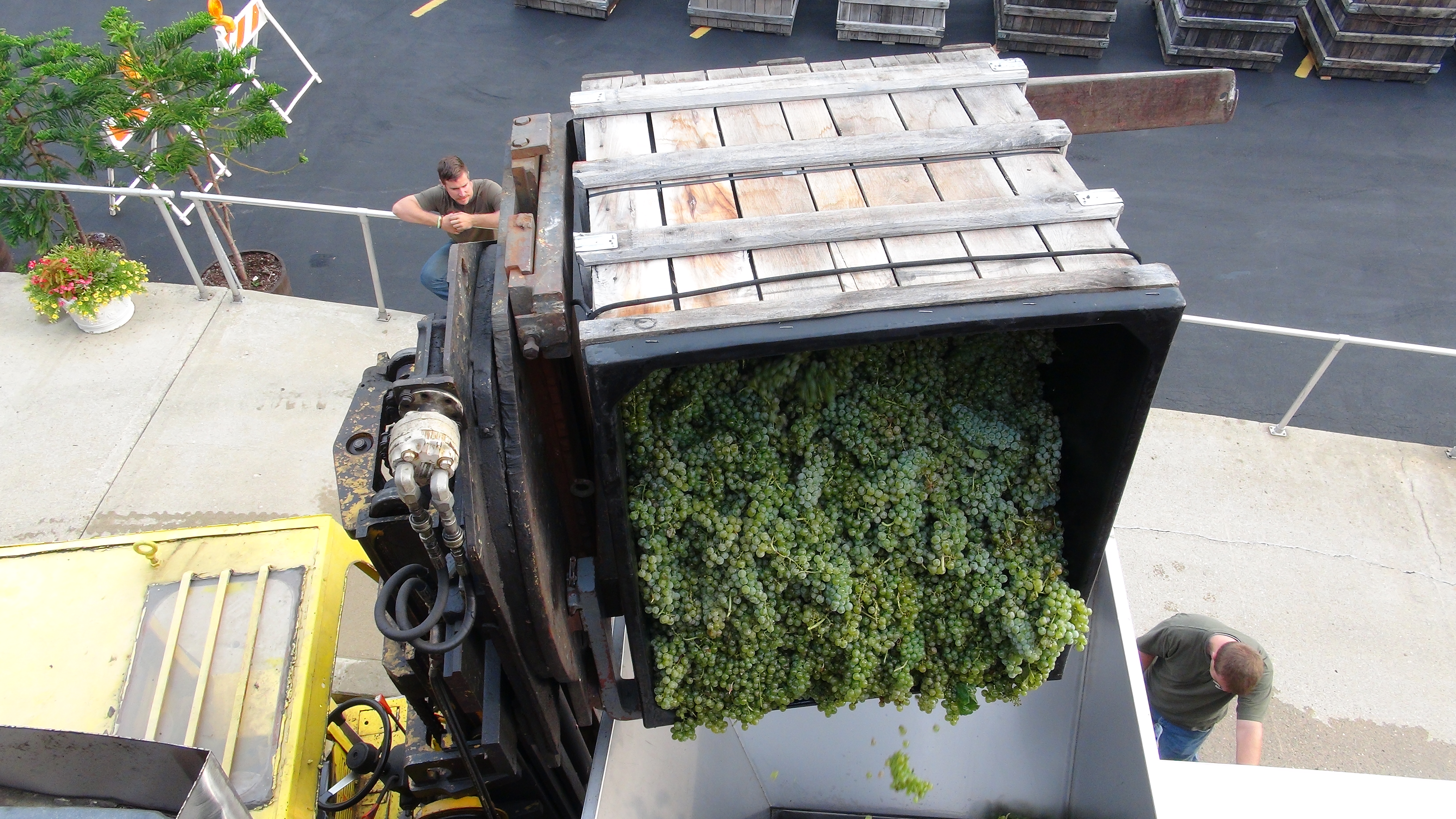
Traminette being delivered to winery in 2014.

Traminette being delivered to winery in 2014.

“After getting the perfect grapes from our vineyard the work begins at the winery crush pad,” the second-generation winery owner said.  “We like to see four to 12 hours of cold soak for the grapes in the large boxes we pick them in. This gets the juice in contact with the sun-exposed skins. We then destem and press the grapes in bladder grape presses. The press uses very low pressure in a gentle way.

Keeping the juice cold throughout the process maintains the wine’s aroma and flavor. “We treat it like fresh fruit,” Easley said. “We like to make our Traminette in a semi-dry style so that it is food friendly.”

The Easley Traminette is widely distributed through Meijer stores. I liked the wine a lot because it was done in a dry style. The signature floral bouquet in Easley’s wine is present without being over-powering. The wine is a great representation of what Indiana can do right.
Michael Symon’s B-Spot Burgers Delivers

Tags

, , ,

There are plenty of places to get a pretty good hamburger in most any town and even more choices for a gourmet burger in larger cities.

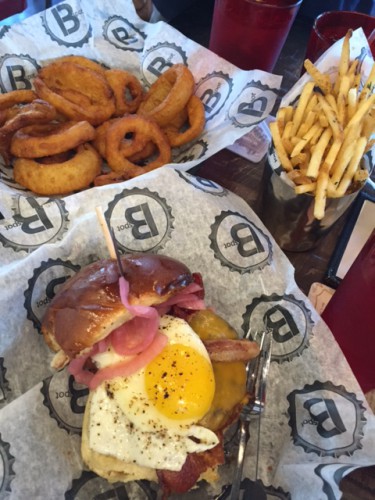
My Lola Burger with shared fries and onion rings.

My Lola Burger with shared fries and onion rings.

Celebrity chef and James Beard award-winner Michael Symon really delivers with his B-Spot Burger joints. His most recent opening at Ironworks, 86th and Keystone in Indianapolis, delivers one of the best burgers I’ve ever eaten.

Symon’s empire started with his signature fine dining restaurant in downtown Cleveland, Lola’s. Several visits there have thrilled and delivered great taste, creativity, and excitement for my palate. B-Spot burgers have expanded the Food Network and ABC The Chew co-host’s empire without the risks of high-end dinning entrepreneurship. Click here for my Nov. 2014 review.

The urban-industrial décor is perfect for a burger joint. Ample outside seating is a nice touch popular with the lunch crowd on a moderately busy Thursday. The menu offers burgers with unique topping mixtures to satisfy any palate – and if not, you can build your own.

Simon is a strict constructionist when it comes to a good burger. He preaches the use of a signature blend of Angus beef, cooked to order seasoned with salt. The toppings add the unique touch to the world-class chef’s sandwiches.

I had the “Lola” burger with melted cheddar, bacon, pickled onions, and a soft-fried egg. I cut the sandwich in two pieces for easier handling. The egg yolk dripped down over the burger for a tantalizing richness. I generally turn my nose up at anything “pickled,” but the onions had just the right amount of onion flavor and tang. It was an incredibly good burger.

3My lunch companion ordered one of Symon’s award-winning burgers, The Fat Doug. That burger comes with cole slaw, pastrami, stadium mustard, and swiss cheese. She loved every bite. We even chopped off bites to swap and offered rave reviews on both choices.

B-Spot serves the same famous “Lola Fries” available in the Cleveland home-base restaurant. The salty, rosemary-seasoned, thin cut potatos are addictive. Since it was a first visit, and wanting to be a thorough food reviewer, we also ordered the onion rings. Frankly, onion rings in too many restaurants often disappoint. But the onions were tender, the breading was lightly seasoned and very crispy. Perfect!

The restaurant offers a huge selection of beers and Symons Bad A** milkshakes. I’m anxious to delve into that portion of the visit during a future visit. The burgers are priced at $8.99 to $10.99. Everything is ala carte so a sandwich side and drink, will cost around $20.

Cleveland's Michael Symon

Cleveland’s Michael Symon

Indy has other “gourmet” burger shops I have yet to try. Symon sets the bar pretty high with his first-time venture into the expanding Indy food scene.

The location might offer a challenge for anyone not familiar with Indy’s northside. The Ironworks building sets at the busy corner of 86th and Keystone Avenue. The restaurant is actually on a back corner away from the two streets. There is a sign at the complex entrance.

I can’t wait to go back. Welcome to Indy Michael Symon!


Easley’s Traminette Tops Indy Competition

Tags

, , , , , , ,

Approximately half of Indiana’s wineries sell a Traminette wine. Wine lovers can find the very sweet to bone dry examples of floral wine in stores and tasting rooms from north to south.

Grape Sense LogoThe hybrid wine grape may have won its crowning achievement in early August at Purdue University when Easley Winery’s 2014 Traminette was named the competition’s 2015 Wine of the Year.

Before writing off the honor as just another ribbon or contest understand the Indy competition is one of the nation’s largest. Wines arrive from 40 states and 12 countries. More than 2,100 wines are tasted during the event.

Indiana recorded 316 medals during the competition. Huber Winery, Starlight, In., was again the Governor’s Cup winner for most awards. Ted Huber was the 2014 Winemaker of the Year. But others had a big showing as well. Country Heritage and Vineyards, near Fort Wayne, took home more than 20 ribbons along with the Indiana Farm Winery of the Year award. French Lick Winery won 19 awards. Turtle Run had its best showing with two ‘Best of Class” winners, two double golds, and two golds. You can find a link for all Indiana awards here.

But after all the awards judges taste the best of the best and selected the Easley Traminette as the show’s best-made wine. The downtown Indianapolis-based winery has been on a roll with the state’s signature grape.

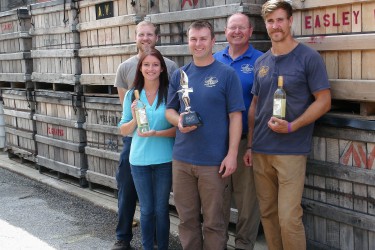
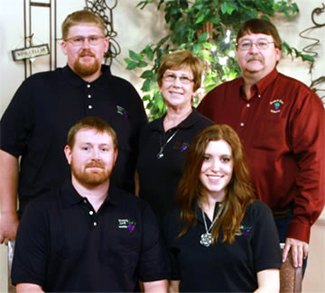
Ryan Robertson, cellar crew, Blake Loudermilk, grower relations, Jeff Martin, winemaker, Mark Easley, Nathan Schaefer, production manager.

Ryan Robertson, cellar crew, Blake Loudermilk, grower relations, Jeff Martin, winemaker, Mark Easley, Nathan Schaefer, production manager.

The 2014 wine won a gold medal at the 2015 Mid-American Wine Competition in Iowa, a double gold at the 2015 Tasters Guild International in Michigan, and a gold at the Great Lakes Great Wine competition in Michigan.

“Back in 2009 we really got behind growing and making Traminette wines,” said second generation winemaker and owner Mark Easley. “Our first Traminette grapes came out of the Kauffman Vineyards in Posey County. The vineyard was owned by our winemaker Jeff Martin’s grandfather, Harley Kauffman. When we saw how well it grew in Indiana, and the fact it was going to become the signature grape of Indiana, it was a no brainer.”

Today the Traminette grapes come from four vineyards all within 300 miles of downtown Indianapolis. “All of our grapes are planted on at least two farms so that we always have grapes even in a frost year,” Easley explained. The farms are located in Harmony, Indiana, Jennings County, Berrien County, Michigan, and Yates County in New York.

Easley produces approximately 2,500 cases of Traminette annually. Some wine or juice is sold off to eight Indiana wineries. Traminette has done so well for Easley he continues to plant. “We’ve been planting one to five acres of Traminette at three of our four farms each year over the last five years.”

Ribbons and medals help sell wine. Easley’s wife Meredith heads up marketing efforts. “Wines that are presented in a tasting room with gold medals typically get tasted more often than those with a lesser medal or none at all,” she said. She explained wine drinkers realize medals come from judges with expertise and background to determine well-made wines.

Meredith Easley said awards validate quality in the vineyard and winemaking. But the goal in the tasting room is to always find the wine a taster likes.

The Easley name is familiar in Hoosier supermarkets like Kroger, Marsh and Mejier particularly with their Raggae line of sweet wines. Their award winning Traminette can be found in many of the same stores.

In the next Grape Sense, Easley will talk about what it takes in the vineyard and winery to make his award winning Traminette.

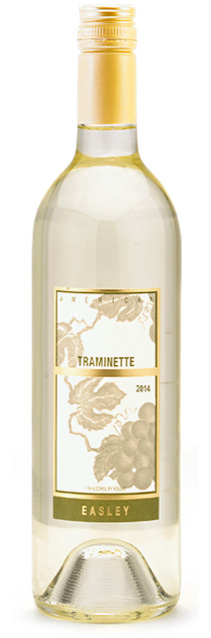
wine-tramHoward’s take on Easley Traminette: The wine is known for its floral nose and taste with apricot and even honey on the palate. For wine purists, it’s most often compared to Gewurztraminer. While too many Indiana wineries let the grapes stay on the sweet to very-sweet style, Easley’s award winning wine is far more restrained. The approach makes the wine more drinkable for those without a palate for sweet wines. (SRP $13.95)

Rain Impacts Indiana Vineyards

Tags

, , , , , , , , , , ,

Indiana’s corn and soybean crops have sustained $475 million in rain and flood damage this summer according to Purdue University agriculture economists. Indiana’s grape crop and vineyards haven’t escaped the soggy summer woes either.

Grape Sense LogoThe rains have hurt vineyards most in Central Indiana while southern vines have been spared. “All the rain this year has made it especially difficult to control diseases,” said Bruce Bordelon, Purdue Professor of Horticulture and specialist in commercial grape and wine production. He said many vineyards avoided disease problems thanks to a dry month of May.

Purdue's Bruce Bordelon

Purdue’s Bruce Bordelon

“But, I’ve seen a tremendous amount of anthracnose (leaf spots and blotches) and black rot. Shocking to see it so bad,” Bordelon said. “In some cases, it is due to a poor spray program, but in others, it is due to high disease pressure. We’ve had too many rains too close together to maintain adequate fungicide coverage.”

Purdue’s grape expert said many of the problems could still be overcome with the most critical weeks of veraison (grape ripening) still ahead.

Don Pampel, owner of Whyte Horse Winery near Monticello, owns one of those vineyards impacted by the downpours. “The heavy rainfall has made some of our vineyards extremely wet and holding water in the rows for extended period of time,” he said. “This has caused stress on the vines and depleted some of the nutrients that they depend on and we are having to spray nutrients where we have not had to in the past. The frequency of the rain has caused challenges to keep the vines protected from fungus that the rain spreads.

“We will not know the damage until it gets closer to harvest and then it is too late.”

Oliver's Parker

Oliver’s Parker

A big challenge with the heavy rainfall is vineyard management. There is the obvious cost of additional spraying and loss of crop but fighting the rainfall’s effect increases labor cost. Bernie Parker, Vineyard Manager for Oliver Winery, said his crews have tried to stay ahead of the heavy rainfall by working the vines.

“Mildews have been a problem but we have had a lot more midseason growth that requires more manpower to manage,” Parker said. “We are shoot positioning and leaf pulling to open the canopy.  This allows for good air flow which helps with drying the clusters and canopy, also reducing the mildew problems.”

Oliver’s Creekbend Vineyard, just north of Bloomington, is on glently rolling slopes allowing excess rainfall to run off preventing flooding. But Parker notes the heavy rains cause a proliferation of weeds to be pulled.

Creekbend was one of many Indiana vineyards to take a hit in 2014 and 2013 from extremely cold winter and spring weather. But Bordelon noted new vines and retrained vines should be benefiting from the additional moisture. Parker agreed that his re-trained vines were looking strong.

Jim Butler

Jim Butler

The rainfall’s impact lessens in the south. At Butler Vineyards, not far from Oliver, things are looking pretty good. “If we get drier weather starting around the first of August we will have a good year,” Jim Butler said. “We have a large crop set on the vines. We have run a tight spray schedule, by that I mean timely sprays of the right materials to prevent the start of fungal infections.”

Butler said normal August weather should deliver a strong crop despite all of the early rains. Rains have been mostly normal in the Ohio River Valley region.

”In Southern Indiana we have been very lucky in missing all of the large rain events and as a result we have remained very disease free,” said Ted Huber, Huber Orchard and Winery. “Vine growth has been very good plus we continue to remain warmer and sunnier than other parts of the state.

“Therefore, many of our varieties are already in veraison and picking up sugars quickly. We estimate that our harvest will being on August 15.”

Huber has the state’s largest vineyard with more than 20 varietals planted. Just down the road at Turtle Run Winery owner Jim Pfeiffer said the rainfall had not caused any problems for his vines.

Bordelon said the heavy rain and resulting challenges means some Central Indiana vineyards are likely to see a reduced harvest. A sunny and warm month of August could boost the crop as ripening gets underway.

Time Again to Uncork the Uplands

Tags

, , , , , , , ,

One of the state’s best, if not the best, wine celebrations returns to Huber Orchard and Winery 4-7 p.m., July 25 in southern Indiana.

Uncork the Uplands is in its fifth year celebrating the wines of Indiana’s only designated American Viticultural Area – the Indiana Uplands. The annual celebration returns to Huber’s after two years at Oliver Winery near Bloomington.

Grape Sense LogoThe Indiana Uplands has nine Indiana wineries coming together for one night of wine, food, and celebration. The event is hosted by Huber in its large Plantation Hall. Huber’s is located in the rolling hills of southern Indiana overlooking the Ohio River Valley near the very small town of Starlight. It’s a short drive from New Albany.

The nine wineries pouring will be Best Vineyards, Brown County Winery, Butler Winery, French Lick Winery, Huber Winery, Owen Valley Winery, Oliver’s, Turtle Run and Winzerwald. Those nine make up the Uplands Wine trail and grow grapes within the Indiana Uplands AVA.

The unique Indiana event also brings in a number of Indiana artisan food purveyors offering samples to pair with the wine. Live music and other events highlight the evening activities.

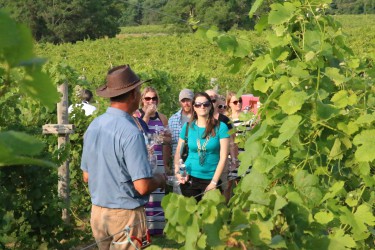
Touring vineyards at Uplands last year at Oliver Winery.

Touring vineyards at Uplands last year at Oliver Winery.

Wine fans can also participate in two guided tours. In one, guests will tour one of Indiana’s largest and oldest vineyards. Huber’s almost 800-acre farm has contributed to Indiana’s agritourism for over 150 years. In the second, tour Huber’s production facility, and see how wines and spirits are created from the ground up.

This year, Uncork will feature add-on tickets for an exclusive VIP event that will take place in Huber’s Starlight Distillery’s new 20,000 square-foot stillhouse an hour before the main event.

VIP tickets include special cocktails, hors d’oeuvres, a keepsake glass and personal interaction with the winemakers from around the trail. Tickets to this event are limited.

One of the best parts of the Uplands event is the chance to talk with the winemakers and family members who make some of Indiana’s best wine. But be sure to get there early and take the vineyard tour. If you’re a real wine fan, there is no better way to learn about wine grown in any region of the world than a walk through a production vineyard.

Tickets are $60 per person and are available at the participating wineries and at the door the night of the event. The fee covers all the food and wine tastings throughout the evening.

With Huber located in the southern most region of the state, you should consider spending the night near New Albany or Jeffersonville and enjoy the historical district, restaurants, and new walking bridge across the Ohio River. The area is going through big positive changes. There are several national chain motels near I-64.

Summer BBQ Wine & Porch Pounders

Tags

, , , , , , ,

Any regular wine column should include occasional education and certainly advice. Summer is a big time for cooking out, family outings, and friends sharing good times.

The first rule of wine is drink what you like when you want it with whatever food you enjoy. With that said, there are some pairings and ideas which work well during summer.

Grape Sense LogoSummer is a time for BBQ of all sorts. While a big Cabernet will always work with red meat, there are other choices for big flavor without the huge finish or bitterness of strong tannins.

If you are doing beef or pork on the grill, perhaps with a bold rub or red sauce, try a Zinfandel or Syrah. These wines are perfect for summer grilling and just might be old favorites you haven’t tried for awhile.

Zinfandel is particularly great for grilled meats because of the usual fruit-forward characteristic of most California Zins. The wines tend to be fruity, balanced, and a perfect match to bold flavored or spicy meats.

And for an inexpensive and easy to find Zin, try “Seven Deadly Zins’ from the Michael David Winery folks of Calfifornia. The wine is great and usually under $15 and a good representation of quality Zinfandel.

It’s also time for Amercians to give Syrah another chance. Syrah has become one of the most unfairly vilified grapes in Anmerican wine production but that is changing. The wine fell out of favor a number of years back, in part, because there was a lot of bad Syrah on the market.

Syrah is getting new respect made more refined, and often, in a lighter and easier to drink style. Syrah should deliver a nice spicy fruit forward characteristic with a peppery-like finish. Syrah and pork pair perfectly for summer dishes.

“Lenore” Columbia Valley Syrah from Washington state is an incredible QPR wine – quality to price ratio. The wine is the second label for Owen Roe, one of Washington’s most respected winemakers. The Lenore can be found at many Midwestern wine shops for $14-$16. It’s a great value. As a matter of fact, the Lenore rates as one of the top bottles I’ve found under $15 in several years.

Now how about those porch pounders? When friends gather on the patio or porch you want something delicious to offer your guests. There are so many great, and easy to find, options beyond the unoaked Chardonnay and Sauvignon Blanc. I think Riesling is a bit sweet for summer heat but try a Kabinett level and that might work for your friends who like a bit sweeter wines.

More traditional recommendations would be a South African or California Chenin Blanc. Upper state Michigan is producing some really incredible dry Pinot Blanc. If you’re in a wine shop, look for Pinot Blanc from France’s Alsace region.

But don’t be afraid to experiment. Spain and Italy offer several different white wine grapes which will delight and surprise you. These whites are quite inexpensive and tasty. And your guests will be surprised with something different.

If seafood is on the deck menu look for a Albarino or “Vinho Verde” from Portugal. Good wine shops will have a bottle or two in their inventory. The wine is gaining popularity each year in the U.S. It’s dry, crisp with fairly bold acidity – a perfect seafood match. Who doesn’t like grilled shrimp and white wine?

All of these white wines can be found for under $20 a bottle and most under $15. Summer is a time to enjoy friends and good times.

The Paradox of Alcohol, Cancer

Tags

, , ,

Anyone who has lived 40 years or so has read all of the conflicting information about what will and will not lead to cancer.

Even more confusing, as modern medical science continues to evolve, there are plenty of flip-flops on what will and will not cause cancer.

Alcohol, and in the case of this column red wine, can contribute to health problems. According to the American Cancer Society, red wine can also raise your cancer risk.

Grape Sense LogoBut let’s not beat up the red grapes just yet. The topic will be red wine but you can really subsitute the word ‘alcohol’ for most references to fermented grapes written here.

Alcohol can get you in a number of ways – from damage to body tissue, effects on other body chemicals, effects on hormones, body weight and much more according to the ACS. But the organization also realizes that many American’s enjoy a glass of red wine with dinner.

The recommended alcohol limit is no more than two drinks per day for men and one for women. And ladies, that’s because of the smaller body size.

There is little debate doubt alcohol can be a bigger risk for mouth and throat cancers, liver, colonn, rectum, and even breast cancer.

And what about the effect of alcohol during cancer treatment? For the most part, in limited consumption, there is no issue according to a report from Cancer Research UK. The bigger issue is a change in taste buds and the acidic taste of wine may no longer be palatable.

But wine isn’t supposed to be good for your health? There are theories and some research suggesting red wine can have health benefits, particularly for heart health. But much of this remains debatable.

Popular Science has even weighed in on red wine and notes red wine is an antioxidant and that it has anti-tumor properties. Reservatrol is the chemical in red wine some have targeted as an anti-cancer agent. An University of Missouri researcher has published information suggesting a connection that reservatrol can make some cancer cells more suspectible to radiation treatment.

But any discussion of Reservatrol has to be taken with a grain of salt. It all started with the “French Paradox.” The term emerged in the 1990s noting the French appetite for high fat and red wine diet but less disease.

Popular Science accurately reported in in a November 2013 website post that Resevatrol has been widely researched but with very little human testing. And one of the biggest problems with Reservatrol as an anti-cancer agent is that there is hardly a town drunk tough enough to consume enough red wine to get the necessary Reservatrol through its most natural source – red wine grapes.

One great fact from that report was it takes two to five grams of Reservatrol for clinical tests. For a human to get that much reservatrol, they would have to consume about 2,500 glasses of wine.

The point of the column is don’t read too much into the big headlines about red wine making you healthier. Don’t read too much either into the evils of the red grape.

For seven years this column has promoted drinking good wine and learning how to appreciate it. We also have to pause once in awhile to remind all consumers that even the best things are appreciated most in moderation.

Howard W. Hewitt, Crawfordsville, In., writes about wine every other week for 22 Midwestern Newspapers. Reach him at: hewitthoward@gmail.com

Indiana 16th Wine Fest Saturday

Tags

, ,

EDITOR’S NOTE: Grape Sense presents a guest column today on Vintage Indiana – a Festival of Indiana Wine. Thanks to my friend Jeanette Merritt, of the Purdue Wine Grape Team for the contribution!

It’s no secret that Indiana wineries make outstanding wine. With 80 wineries and nearly 1.5 million gallons of wine being made in the Hoosier state, there is sure to be a wine for anyone’s taste.

Merritt

Merritt

One of the easiest ways to find a winery you enjoy is to visit a festival. As the Marketing Director for the Purdue Wine Grape Team and Executive Director of the Vintage Indiana Festival, I highly recommend you make plans to be in Indianapolis on June 6, 2015 for the biggest and best celebration of Indiana wines!

Vintage Indiana was started as a way to celebrate the role of Indiana wineries and vineyards as part of agriculture and tourism. Wineries contribute millions of dollars to the states economy and have helped to revitalize small communities around the state.

Vintage Indiana brings 30 wineries from around the state to Military Park, a city block park in downtown Indianapolis. The event is a one-stop shop for wine consumers. Guests, ages 21 and over, can pay one ticket price, receive a wine glass and sample from wineries like Oliver Winery, Easley Winery, Country Heritage Winery & Vineyards, and Rettig Hill Winery, to name only a few.

General admission tickets are good from 12 p.m – 6 p.m. and cost $25 in advance at Marsh Supermarkets or online at http://www.vintageindiana.com. Or you can purchase the tickets for $35 at the gate.

Vintage Indiana also offers an Early Admission ticket. Ticket holders can get in the event one hour early, at 11am. Guests holding the early admission ticket will receive a special wine glass, a VIP wine glass lanyard and the chance to have the best seats at the music stage. Early Admission ticket holders will also be the first in line at the wine tents and have the best chance to purchase their favorite wines.

Grape Sense LogoIf you intend to sample wine, you will want to eat at some point during the day. There are great food options, ranging from turkey drums and brats from the Indiana State Poultry Association, great pizza from Bazbeaux and Brozzini’s, and some tasty Chinese and Caribbean bites from a few of the best food trucks in Indianapolis.

Vintage Indiana celebrates art and music as well. Indiana Artisans will display their wares for sale during the festival. You can buy anything from recycled wine bottles turned into things like windows and cutting boards. Or there is jewelry that will become a staple in your wardrobe. And there are painters who showcase their beautiful canvases. Bring extra money because you will want to take some of these items home!

Vintage Indiana features great music from Indiana bands that will keep your toes tapping all day long! Jennie DeVoe, Zanna-Do and Living Proof will all take the stage to provide great sounds throughout the day.

And while the music, food and art are great, it is the outstanding wine that brings people to Vintage Indiana. 10,000 guests will celebrate the Indiana wineries and the vital role they play in our agriculture and tourism industries. Wineries will offer samples of their best Chambourcin, Traminette, Vignoles, Cabernet Franc, Rhubarb and sweet Concord wines. There is a wine for those who have never tried wine before. And there are wines for those who consider themselves connoisseurs.

Indiana’s wineries and vineyards are just as much part of agriculture as corn, soybeans, hogs and cattle. Our industry may not take up as many acres as the corn and soybean fields you see dotting the countryside, but are all still farmers! And our wineries want to see you at Vintage Indiana on June 6!

Jeanette Merritt is the Marketing Director for the Purdue Wine Grape Team and Executive Director of the Vintage Indiana Wine Festival. She can be reached at jkmerritt@purdue.edu

Legislature Right – For a Change

Tags

, , , , , , , ,

Indiana’s legislature showed a small bit of sanity in getting a shipping law passed for Hoosier Wineries before closing the most recent session. Governor Pence signed the bill into law.

Phil Boots

Phil Boots

Grape Sense LogoSen. Phil Boots, R-Crawfordsville, gudied the legislation removing the face-­to-­face requirement for Indiana wineries to ship wine to their customers. At one point, the licensing fee went from $100 annually to $500. That was plain and simple another case of the legislators bowing to the powerful liquor lobby, funded largely by alcohol distributors.

He urged supporters to keep the foot on the gas and in the end the fee structure was set up on a graduating scale depending on production and alcohol shipped. A fair, if not arguably unnecessary, solution.

Kim Doty, standing center, with husband John and family.

Kim Doty, standing center, with husband John and family.

Indiana wineries could not be happier.

“When the law requiring an initial face to face transaction became effective, it literally destroyed our shipments to wine customers,” said Kim Doty, owner of French Lick Winery.

“We lost 95 percent of our wine shipping sales. Our wine sold and shipped to customers in 2004 was about 10 percent of our total sales. Today with the face to face requirement, our shipping sales are less than one tenth of 1 percent of our total sales. This requirement has also had a negative impact on the growth of our wine club with 99 percent of our wine club sales are shipped directly to the home.”

Again, that face­-to-­face requirement was added to legislation in 2008 as a token to the alcohol lobby but crippling, in particular, to small wineries.

Wineries like French Lick were forced to play along but at a steep price. “We have accumulated over 5400 completed verification forms to date. We would have sold and shipped at least twice that if not for the requirement.”

The new law requires age verification but all shipping laws generally do. Wineries can meet the requirement by using an age verification delivery service like FedEx or UPS.

“We are thrilled with having the requirement rescinded,” Doty said. “Age verification will still be performed by the delivery company and we will pay additional fees for this service. We are confident that our wine shipments are properly handled in accordance with Indiana’s age requirement for liquor.”

Jim Butler

Jim Butler

Jim Butler, Butler Vineyards near Bloomington, has long been one of the industries leading spokespersons and advocate for sanity in wine shipping laws and more.

“We are basically back to where we were 9 or 10 years ago,” Butler said. “With the face to face requirement we l lost 90 percent of our shipping business. Perhaps now we can build it back. This is a nice step forward. It is always a battle of the titans at the statehouse about alcohol issues, big money. big players. We are just little guys. It is one small step toward sanity.”

Sanity? That seldom happens with the legislature and liquor laws. Just look at what happened this year with Sunday sales. A simple law was mangled with requirements that would have retailers build walls in existing stores to sell alcohol on Sundays.

Fortunately, the legislature got it right for Indiana wineries, big and small, in 2015.

Red Wine Turning Green

Tags

, , , , ,

The excitement, debate, and controversies over organic wine, natural wine, wine bottle waste, and wine closures never to come to an end.

A few years ago the big closure movement was to screwcaps for what was usually lower priced wines. Wine closures now include cork, synthetic cork, glass stoppers, and more. The latest is an effort to further turn wine green with Bio Zero Carbon footprint stoppers. Avalon Winery, Sonoma, is promoting the closure as the first winery in the U.S. to move to the latest environmentally – friendly stopper.

Grape Sense LogoThe Graton, California, winery has long been interested in sustainability and good green practices. They have a rainwater system which helps protect local salmon and house bees for local beekeepers in the vineyard, according to their marketing folks.

The winery management team had been interested in green packaging, sustainability all while keeping wine quality at the highest levels. Then in 2014 Select (r) Bio by Nomacorc emerged as a cork alternative made as a plant­-based polymer cork made from sugar cane.

avalonFrom the press materials, the benefits include:

– Prevents cork taint. (spoiled taste)

– Allows some needed oxygen exchange required by all wines.

– Crumble free and won’t break.

– Produced with 100 percent renewable energy.

­ 100 percent recycable with other plastics.

While many wine drinkers have a hard time being tree huggers, especially when you consider the use of such heavy glass in many wine bottles, these type of efforts are worthy of note.

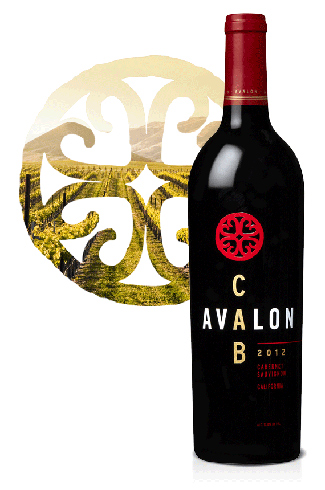
Avalon sent a long a bottle of its 2012 Cabernet. The wine is 76 percent Cab, 13 percent Syrah, 7 percent Zinfandel, and 4 percent Merlot. Grapes come from Napa, Lodi, Paso Robles, and Monterey County. The wine was aged in a combination of French and American barrels for eight months. That sort of wine geekiness is really only important to me for this column when winemakers are talking about new closures and other innovations.

I thought the wine was a terrifc value. It’s not quite the level of a fruit bomb ­ and that’s good thing ­but is soft, well rounded and very drinkable. The wine was varietally correct ­ it sure tasted like Cabernet. I try to judge wines for what they are and the Avalon Cab was a darn fine SRP $12.99 bottle. (Trade Sample)