• About
  • Indiana Wineries
  • Michigan Wineries
  • Wisconsin Wineries

Howard W. Hewitt

~ … The "W" stands for wine!

Howard W. Hewitt

Category Archives: Newspaper Column 2012

Wines to Go; Summer Sippers Abound

25 Monday Jun 2012

Posted by Howard in Newspaper Column 2012

≈ Leave a comment

Tags

Copia, Grape Sense

Wine by the glass is a novel concept that has nothing to do with that expensive pour you recently had at a restaurant.
Perhaps you’ve noticed the displays in your local town’s pharmacy. Single-serving wines are now available at some of the major drug store chains.
The Oregon based company behind the little glass to go is Copa Di Vino, or wine by the glass. The glass is made of recyclable plastic. It has a plastic cap and a foil seal.
Founder James Martin got the idea while in France, according to the product’s website. Martin was traveling on a high-speed train in when he first saw wine bottled by the glass.
Locally, the pharmacy had the Cabernet Sauvignon, Chardonnay, Pinot Grigio, and Merlot. But the company also offers Riesling, and White Zinfandel. You can buy it by the case for around $36 or individually for about $3.
I tasted the Cabernet Sauvignon and Pinot Grigio for this column. The Cab was a typical under $10 a bottle Cabernet. The wine was varietally correct with a bit of unpleasant astringency. But it also was not unlike many under $10 Cabs I’ve tasted. The Pinot Grigio was equally okay. I thought it was a bit on the tart side for the normally mild mannered wine .
Would I recommend either strictly based on taste, no way. But for convenience knowing, what you’re going to get, perhaps.
Obviously, the idea is to enjoy a fresh glass of wine without opening an entire bottle. You can do the same thing though with the much-improved boxed wines now available.
But who is the target audience for this product? If the family is headed out on a picnic and you don’t want to mess with cups, glasses, a bottle and opener then it makes some sense. Do we need wine by the glass at the corner drug store? I’ll leave that for consumers to decide.
Great Summer Sippers– Summer time is white wine and Rose time. Here are a few I’ve sampled lately that are widely available and very affordable: Santa Barbara 2007 Sauvignon Blanc, $12, light wine with good acid; Clayhouse Adobe White, $14, a rich smooth blend ; Arona Sauvignon Blanc, delightful with crisp acidity; Gerard Bertrand 2010 Gris Rose’, $14, wonderfully dry Rose’, Bieler Pere et Fils Rose’, $11-$14, Southern France blend that tastes like expensive wine.
Off to Bordeaux – Check out my wine blog (www.redforme.blogspot.com) between June 27-30 for updates from France during the Bordeaux Fete le Vin or Bordeaux Wine Festival. I’ll be there as a guest of Bordeaux producers for the every other year celebration of the world’s most famous wine region’s wines. I usually blog each night during such trips and try to post lots of photos. This festival draws more than a half million visitors. Our press group will be visiting a couple of Chateau in the Saint Emilion region near Bordeaux and learning about the burgeoning wine tourism.
Howard W. Hewitt, Crawfordsville, IN., writes about wine every other week for 18 Midwestern newspapers.

Send comment or questions to: hewitthoward@gmail.com

Share this:

  • Click to share on X (Opens in new window) X
  • Click to share on Facebook (Opens in new window) Facebook
  • More
  • Click to share on LinkedIn (Opens in new window) LinkedIn
  • Click to email a link to a friend (Opens in new window) Email
Like Loading...

Rosso di Montalcino a Great Wine Buy

15 Friday Jun 2012

Posted by Howard in Newspaper Column 2012

≈ Leave a comment

Tags

Italy, Rosso di Montalcino, Sangiovese

Wine made from the Sangiovese grape may be the most diverse in the world.

The little black grape is closely associated with Italy and rightfully so. But it is also grown in Argentina and California. But in Italy, Sangiovese is king – the most widely planted grape in a country that ships more wine to the U.S. than even France.

Perhaps some readers have never heard of the grape? But if you’re a regular wine drinker it’s highly probably you have consumed wines made from Sangiovese.
That popular 60s and 70s bottle with the basket covering – that’s Sangiovese. If you’ve ever consumed a Chianti or Chianti Classico in a restaurant or bought a bottle – that’s Sangiovese wine.  Perhaps you’ve picked up a Rosso di Montalcino or the high-end Brunello. Both of those wines are Sangiovese.
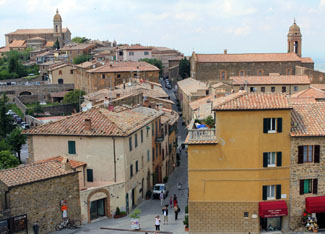
A view of the hilltop town of Montalcino

I recently returned from Italy on a business trip and had the opportunity to drink a good amount of Rosso di Montalcino, or ‘baby Brunello’ as some will call it.

But first, let’s do some geography for novices. Florence sets in the north central region of Italy. Tuscany starts north of Florence and runs down through Siena. Just south of Florence you find the Chianti region of Italy and at its heart is the Chianti Classico designation. Remember, old world wines from France and Spain are named by region and not the grape.
Italian law dictates the blend for Chianti and Chianti Classico has to be 75-100 percent Sangiovese, up to 10 percent Canaiolo and up to 20 percent  of any other approved red grape variety such as Merlot, Cabernet Sauvignon, or Syrah.
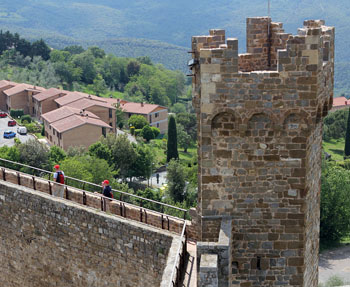
A little farther to the south you enter the Montalcino region, centered around the lovely hilltop town of that name crowned by an ancient castle. The grapes there are also largely Sangiovese. Montalcino is the region for Sangiovese’s best representation in a bottle, Brunello wines.
Brunello is 100 percent Sangiovese and must be aged in oak at least two years. The wine tends to be silky smooth and full-flavored with considerable acidity which makes it perfect for food.
A photo I took from atop a castle tower in Montalcino

The problem with Brunello for many consumers is you can barely touch a bottle in the U.S. for $50.

The better alternative for most will be Rosso di Montalcino. The differences are, frankly, easy to understand. The winery owner or winemaker selects the very best grapes from their vineyard to make Brunello. The remainder of the crop goes into the Rosso which is often referred to as ‘table wine.’
Rosso di Montalcino is aged for just one year so you get a wine that is less tannic. The Rosso is richer and easier for wine novices to drink than it’s big brother Brunello.
I’m nearing the conclusion that Rosso di Montalcino might be the best value-for-the-money wine that you can pick up off a wine shelf. You can find Rosso wines anywhere from $15-$30. There are plenty of great selections at $15-$20.
You’ll get a great food wine but also a wine that can be sipped. The taste will have a smooth and often silky flavor. It will feature a recognizable cherry flavor from the great Chianti-styled Sangiovese wines. It will be less tannic and more rewarding for novice wine drinkers.
Sangiovese wines are great with red sauce Italian dishes, pizza and red meats.
Rosso di Montalcino is a wine you might never find in a supermarket and few liquor stores, but it’s worth the search. Most wine shops with a good selection of Italian wine will have a few bottles of Rosso di Montalcino.
Ciao!
Howard W. Hewitt, Crawfordsville, IN., writes every other week about wine for 18 Midwestern newspapers.

Send comment or questions to: hewitthoward@gmail.com
Share this:

  • Click to share on X (Opens in new window) X
  • Click to share on Facebook (Opens in new window) Facebook
  • More
  • Click to share on LinkedIn (Opens in new window) LinkedIn
  • Click to email a link to a friend (Opens in new window) Email
Like Loading...

Not Your Granny’s Pink Wine Any More

04 Monday Jun 2012

Posted by Howard in France, Newspaper Column 2012

≈ Leave a comment

Tags

Bieler Pere et Fils Rosé, pink wine, Provence Rosé, Rose'

Those silly looking pink wines in your favorite wine shop or liquor store are gaining respect through robust sales. Rosé is perfect for the summer’s hot weather and sales are even hotter.

The numbers are staggering. Since 2009, overall consumption of Rosé wines has increased 160 percent.

Arguably, the best Rose’ in the world comes from Southern France. Exports of rose’ wine from the Provence region to the U.S. grew 62 percent in volume last year compared to 2010. Value of exports for the 2010-2011 period increased nearly 50 percent to a record high of nearly $10 million Euro.
The booming growth can be dated back to 2003 when Provence exported 146,000 liters of Rosé to the U.S. Last year that number easily passed 1.7 million liters.
Bethann Kendall, Vine and Table

But the U.S. isn’t the only major importer of the salmon-pink Rosé wines. Sales have also increased significantly in Brazil, Russia and other countries.

“What we’re seeing in the U.S. market reflects a global trend,” said Julie Peterson of the Vins de Provence U.S. office, which provided the statistics above. “Those who appreciate great wine and the Mediterranean lifestyle are turning to Provence rosé for its versatility, food friendliness, and gold standard quality.”

Midwestern wine retailers have also noticed the explosion in growth.

“Rosé sales increase more and more very year,” said Bethann Kendall, wine buyer at Vine and Table, Carmel, IN. “Last year was probably almost three times more than what I sold my first year here.  And right now, in May, I’ve already sold more than what I sold all of last year. It’s looking great. It’s going to be a huge increase probably 15-20 percent.”

Provence Rosé is made from a blend of basically six grapes. Grenache, Cinsault, Syrah, Mourvedre, Tibouren, and Carignan can be found in Provence’s signature wine. But around the world you can find Rose made from just about any grape varietal imaginable. Oregon, home of some of the U.S.’s best Pinot Noir, makes great Rosé of Pinot Noir wines.
For years “pink wine” was soiled in reputation by white zinfandel but no more. “I think there is still a huge misconception on Rose but we taste it every Saturday,” Kendall said. “I’m always opening a bottle to try to sway people in the right direction. It’s not all sweet. I tell them if they don’t like Provence Rose they’re just not going to like it from any region at all.”
Howard’s Picks:
2011 Bieler Pere et Fils Rosé – Simply Unbelievable Provence for a miserly $11-$14. This dry delicious Rose is a blend of 50 percent Syrah, 30 percent Grenache, and 20 percent Cabernet. Bigger than some Rose’ but the cranberry color and wonderful taste of red raspberry makes it a real must buy. “I was excited to finally get it into Indiana,” Kendall said. “It sells out every vintage and it’s just true to the area with very beautiful strawberries and raspberries and a nice chalky texture which comes from the soils of Provence.
2011 Mas de Gourgonnier – Cherry and classic Rosé strawberry with hints of spice make this Rose a real treat for around $15. While a little lighter in style than the Bieler, it’s equally dry. This wine is 60 percent Grenache (my favorite) with a 40 percent blend of Syrah, Mourvedre, Cinsault, and Cabernet. This is a perfect hot weather wine and gorgeous pairing for lighter foods.
More choices: Chateau Revelette Provence Rose’ (Wine critics: 89-90 Points and the best I’ve tasted this year); Acrobat Oregon Pinot Noir Rosé, $15; and closer to home Butler Winery’s Rosé of Chambourcin, $14-$15.

POSTSCRIPT: Rose has been in the news a lot lately. Here are some links to additional stories about Rose.

From SFGate, San Francisco, another from the San Francisco Chronicle, from the Cleveland Plain-Dealer, the Los Angeles Times, the Chicago Tribune,  

Send comment or questions to: hewitthoward@gmail.com
Share this:

  • Click to share on X (Opens in new window) X
  • Click to share on Facebook (Opens in new window) Facebook
  • More
  • Click to share on LinkedIn (Opens in new window) LinkedIn
  • Click to email a link to a friend (Opens in new window) Email
Like Loading...

Story Behind Michael David’s 7 Deadly Zins a Tasty Tale

21 Monday May 2012

Posted by Howard in California, Newspaper Column 2012

≈ Leave a comment

Tags

7 Deadly Zins, Michael David, Michael Phillips, Zinfandel

The story behind one of the best tasting and most successful value wines has good winemaking, gratitude to terrible sweet wine, and a long family history of fruit production to credit for its success.

7 Deadly Zins is one of the easiest to find value wines in the $10-$15 price range. It’s 100 percent Zinfandel and consistently a favorite of critics and fans. It’s made by Michael David Winery, Lodi, Ca., an area best known for its full-flavored Zinfandel.

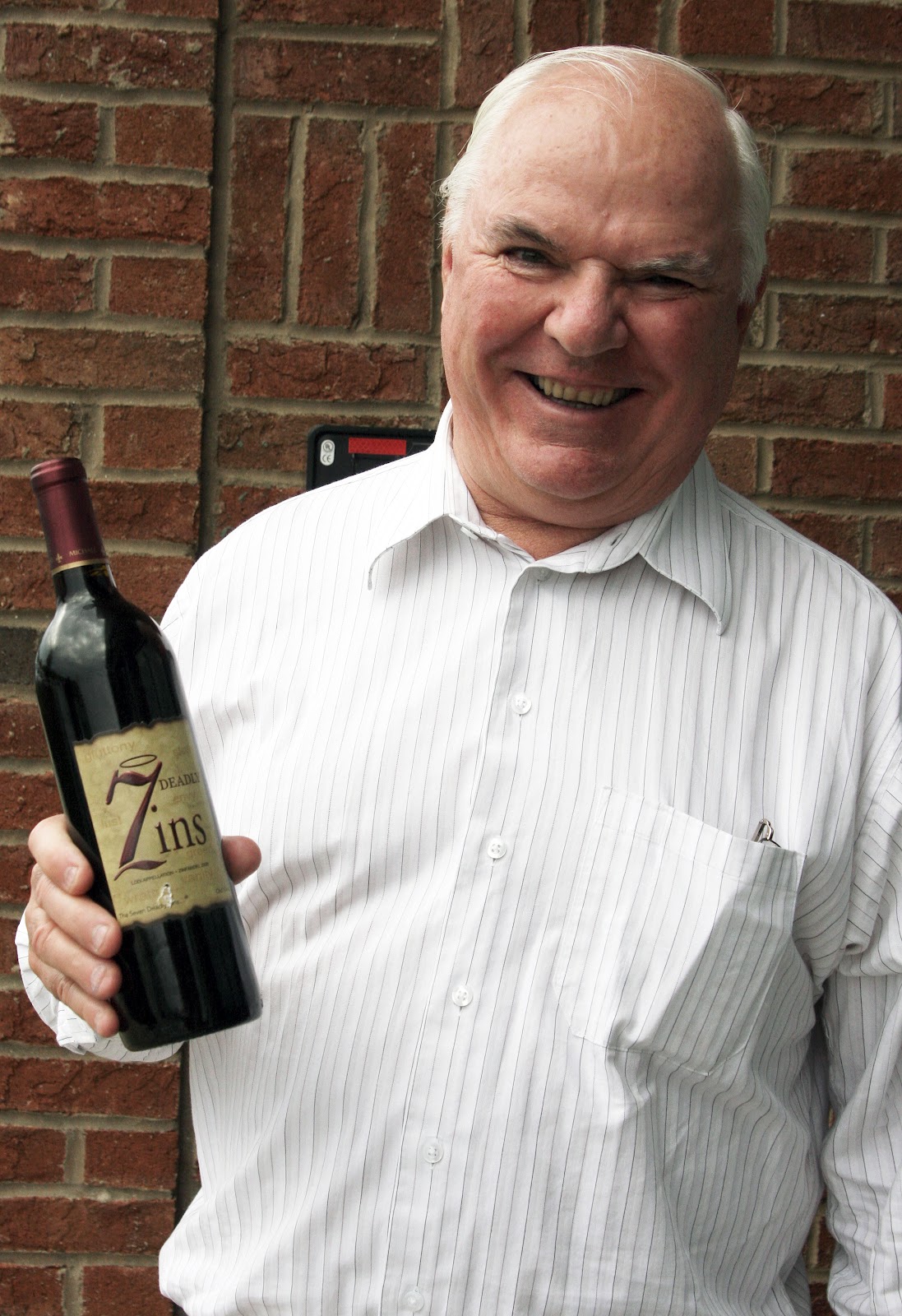
“I was in the winery making wine and I wanted to taste what other vineyards tasted like for Zin,” Michael Phillips recently told me. “So I bought some grapes from my seven growers and put them in barrels separately. You could taste the difference between those seven old vine vineyards. The grapes were grown by my uncle, neighbor across the street, cousin down the road, and my best friend from high school. We had a couple old vineyards next to the winery. They were all different to a certain extent.”
Michael Phillips during a recent Indianapolis visit.
Phillips recognized a distinct taste of Lodi in all seven wines but knew his winery couldn’t bottle seven different Zinfandels and expect success. 
“So I said lets combine all seven and call it 7 Zins,” Phillips said. “So I went to my brother (David), who was doing more of the marketing at the time and gave him my idea. He said let’s tie it to the seven deadly sins we learned in grammar school. We made 800 cases that first year and sold out in two months.”  
To say the wine took off is a bit of an understatement. The 2002 release of 7 Deadly Zins was gone in no time and the brothers knew they had found something special. The Michael David Winery today produces nearly 300,000 cases of wine annually with more than 200,000 cases under the 7 Deadly Zin label.
Back when it all started in the 1980s the winery was simply known as Phillips but there were other Phillips wineries in California so the brothers put their first names on the bottles to become Michael David Winery.
The family story actually goes back much further. The Lodi family farm has been producing fruit of all sorts since the 1860s.
The brothers have fun with the names and labels marketing wines under the names of Earthquake, Incognito, Rapture, and even Freakshow. But it’s that $9-$12 Deadly Zin that makes the fun possible.
Zinfandel has been called “California’s grape.” As opposed to Cabernet, the Zin vines thrive past 100 years old and produce deeply flavored grapes.
“That’s what put Zinfandel on the map,” Phillips said. “It’s that taste of spice, the fruit and it’s easier to drink than tannic Cabernet.”
Oddly, California’s old vine Zins were probably saved by what many consider the bane of the wine Zin industry – white zinfandel. “Whie Zin helped those vines survive,” Phillips said. “When Sutter Home wanted all that white Zin in the 70s it kept those old vines from being ripped out and planted to whatever Gallo wanted at the time.”
Zinfandel is one of those wines that is sometimes targeted for its over-the-top fruit and alcohol. Phillips fights right back.
“We have a style it took me time to develop,” he said. “The longer we let the grapes hang on the vine the better  quality gets. The alcohol is going to be a little higher, but if you handle it right it’s not a negative. You get better color, more body and basically that’s our Michael David style.
“Fruit is good. People want fruit. Now, it can’t just be fruit and it can’t just be high alcohol. It can’t just be big tannic wine either. That’s why Napa buys so much of our Lodi fruit because it has a fruit component they don’t have. That’s the kind of stuff they don’t want you to know or tell you about but fruit is the key. People like fruit, and so many people are switching to that style – and Lodi has it.”
Howard Pick’s:
7 Deadly Zins – This easy to find value bottle can be found at $9-$14 a bottle. It is consistent and easy to appreciate. It has a bold in-your-face dark fruit flavor on the palate that pairs well with food.
6th Sense Syrah – This French-style 100 percent Syrah is beautiful wine that’s stunning for the $15 price point. It has a huge rich nose, dark purple color with hints of licorice, juicy dark fruit and a very pleasant and lingering finish.

Send comment or questions to: hewitthoward@gmail.com

Share this:

  • Click to share on X (Opens in new window) X
  • Click to share on Facebook (Opens in new window) Facebook
  • More
  • Click to share on LinkedIn (Opens in new window) LinkedIn
  • Click to email a link to a friend (Opens in new window) Email
Like Loading...

Top Wines From Your Supermarket Shelf

17 Tuesday Apr 2012

Posted by Howard in Newspaper Column 2012

≈ Leave a comment

Tags

Bogle, J Lohr, Mirrasou, Robert Mondavi

As much as I’d like friends to quiz me about a great $50 Pinot Noir, most of the inquiries are about supermarket wines.
I’ve written many times in the previous 90 columns about such wines and what I think is most palatable. I’m a fan of Mirrasou, Mondavi Private Selection, Smoking Loon, and a few others. All can be found for $10 or less at most markets.

One of the reasons I’m still writing this column is to share information and hopefully a little wine education. I see a lot of wine-related news every week. Most casual vino consumers aren’t going to be interested in the wine-geeky stuff I consume. But every now and then there is wine news that I think is not only interesting but helpful.

If you are a supermarket wine buyer, wouldn’t you like to know what others are buying and most consumers think are top brands?
A consumer research group, Symphony IRI, annually reports its Top 30 momentum wine brands. The report bases its chart on sales data, volume and dollar sales, volume share in the price range, and other measures.  More than 100 brands met the minimum sales of 100,000 cases to be considered.
In a report on winesandvines.com , the survey showed Cupcake wines repeating as the top such wine in the country. Next came Barefoot, Apothic, Liberty Creek – those previous three all owned by Gallo – then St. Michelle’s 14 Hands and Menage A Trois.
Gallo wines held down the number-eight spot with a familiar name, Fish Eye.  Bogle came in at 11th, Columbia Crest was 14th, J Lohr was 17th, Almos 18th, Mark West 19th, chateau St. Jean 20th, Woodbridge 22nd, Sutter Home 23rd, Yellow Tail 26th, Gnarly Head 27th, and Sterling 30th.
Overall, the survey reported, most of the brands had strong growth by improving quality and marketing. Prices were also down per bottle over 2010. 
If you looked at the entire list of 30 labels, what most folks might find surprising is one company owns seven of those brands. What shouldn’t be surprising is that company is the giant Gallo label.
What does all this mean? Not much if you’ve tried the wines and didn’t like them. But if most of your buying is from the supermarket, these labels are easy to find. Obviously, the brands sell well and many supermarket wine shoppers find them to be good wines.
Higher Priced Wines Re-gaining Market Share
At the other end of the spectrum premium wines are coming back. After the economic downturn of 2008, several Central Indiana retailers said they couldn’t move a bottle of wine that cost more than $20-$25. 
During the first quarter of 2012, wines at $20 or more grew in sales 24 percent over last year.
People still love their Cabernet and the bigger prices are also making a comeback. Cab sold more than any other varietal in the top price categories. When you look at those $20-plus wines, most are Cabs. Pinot Noir continues to rock wine drinkers’ worlds with a 32 percent gain over a year ago for wines above $20.

Send comment or questions to: hewitthoward@gmail.com

Share this:

  • Click to share on X (Opens in new window) X
  • Click to share on Facebook (Opens in new window) Facebook
  • More
  • Click to share on LinkedIn (Opens in new window) LinkedIn
  • Click to email a link to a friend (Opens in new window) Email
Like Loading...

Difference Between 2-Buck Chuck & $50 Pinot

05 Thursday Apr 2012

Posted by Howard in Newspaper Column 2012, Wine Education/News/Updates

≈ Leave a comment

(NOTE: This post and the one below are my last two wine columns. Occasionally old age seeps in and I forget to post these to this blog. All of my columns – all 90 to date – can be read at the link Grape Sense on the right hand side of this page.)

Among wine novices the differences between $6 wine and a $100 bottle remains a mystery.

One of my favorite anecdotes on that comes from a speech at a Central Indiana Kiwanis Club. I talked for about 10-15 on wine basics and then one member asked about $50 wine and why that’s better than a cheap bottle. I knew the guy was a golfer. Somehow and someway I came up with one of my best adlibs.
“I know you play golf, right,” I asked. “Well tell me, why do you use a $250 driver when Wal-Mart has drivers for $40?”
It got a laugh but also made the point. More expensive products of any type are usually more expensive based on brand, marketing, craftmanship, and better quality raw materials. The same can be said of wine. There are many factors contributing to price.
While standing in a Paso Robles vineyard in 2010 the grower explained part of his vineyard was for his higher-end Merlot. Another part of the vineyard’s grapes were sold to a bulk wine producer. The grape grower annually ‘drops fruit” or simply cuts clusters from the vines. Just like a flower or fruit in a garden, when you give the vine less produce the result is richer and better product.
But the price has to go up. Dropping fruit reduced the growers harvest to about 2-3 tons per acre. The vineyard for the bulk wineries produces up to 7 tons of grapes per acre. Prices vary by region and prestige, but it’s fair to say for a region like California’s Sonoma County the average price for one ton of wine grapes is around $2,000. Wine prices start to make some sense when you do the math.
But let’s not stop there. Chardonnay is California’s most-planted grape so it can be purchased around the $1,200 a ton mark. Cabernet or Pinot Noir grapes from the best areas can command more than $3,000 a ton. (Statistics from Sonoma Ranches.com)
Though there are many variables, here are some fun statistics: 1 ton of grapes can produce two barrels of wine. Each barrel holds 60 gallons or 25 cases equaling 300 bottles.
Grapes for better wines are handpicked, sorted, and treated like new born babies. Bulk or mass-market wine can be machine picked, machine sorted, and blended or aged in huge vats and barrels. The big-price wines are aged in small lots. I like to think of it as getting more love and attention.
Next comes marketing and reputation. You can search the cost of a bottle of wine and find a lot of different explanations. But it’s fair to assume that a single bottle of wine can cost from a few dollars to $40 or $50 to produce. France’s Revue de Vin De France reported just a couple of years ago that Dom Perignon Champagne costs about $30 a bottle to produce. But the world’s best-known bubbly retails for  nearly $200.
J. Lohr and Louis Martini make really good $15 Cabernet  and its available at Kroger. Robert Mondavi Reserve wines sell for $135-$165 a bottle. Mondavi is a wine made with better products, more craftsmanship, and a big name with a big marketing budget.
Is there a huge difference in the taste? Frankly, the differences are for more discerning palates. If poured an expensive wine, I believe even a novice will note it’s pretty good and clearly better. But how much is that worth for most wine drinkers?
Helping the average drinker find $12-$15 wines that taste like $20-$30 wines is why I write Grape Sense.

Send comment or questions to: hewitthoward@gmail.com

Share this:

  • Click to share on X (Opens in new window) X
  • Click to share on Facebook (Opens in new window) Facebook
  • More
  • Click to share on LinkedIn (Opens in new window) LinkedIn
  • Click to email a link to a friend (Opens in new window) Email
Like Loading...

Napa/Sonoma Still Reign Supreme

05 Thursday Apr 2012

Posted by Howard in Newspaper Column 2012

≈ Leave a comment

Tags

Andretti, Arista, B.R. Cohn, Chateau St. Jean, Davis Bynum, Gary Ferrell, Gloria Ferrer, Inman Family Vineyards, Joseph Phelps, Kokomo Vineyards (and visit Hoosier native Erik Miller), Merry Edwards, Miner, Mondavi, Napa County, Rochioli, Sawyer Cellars, Sonoma County, V. Satui

Oregon’s Willamette Valley is one of the great wine vacation destinations in the U.S. Washington’s Walla Walla region is emerging behind its rich and soft red wine blends. If wine travelers insist on California travel check out the Zins, Pinot Noir and interesting blends of Mendocino County. If you like your wines big and bold at an affordable price, try Paso Robles on the Central Coast.

But if you’re really into wine and want this country’s most unique – and expensive – wine vacation, sooner or later you have to go to Napa and Sonoma counties north of San Francisco.
Wine and wine tourism finds its roots in this country’s most famous wine valleys. I recently spent a couple days there, the first time in five years, and still find it the Mecca for wine lovers.
The area comes with a word of caution for the average wine tourist. Sonoma County lodging and restaurants are not inexpensive. And Napa Valley makes Sonoma look cheap!
Anything above a national chain motel, and there aren’t many of those, can run into the hundreds of dollars nightly. Those national chains can be found at competitive rates ranging from $100-$150 a night. The nicer inns and lodges go for $250 and up. Things won’t be quite as expensive in Sonoma but close.

There are pizzerias, bistros, and burger places in the two counties which are affordable. The real experience is to shop the local groceries, most of which have deli counters where you can pick up great sandwiches. The finer dining establishments compete with any in the world. The French Laundry, Iron Chef Masaharu Morimoto, and many others offer world-class dining.

But people go for the wine and there is no place quite like Napa. Robert Mondavi winery is the heart of this Mecca of American wine. The late icon gets and deserves so much credit for bringing American wine to the world and bringing the world to Napa Valley. His mission-designed winery is a must stop. There are two tasting rooms. The first is for most tourists and wine consumers where you can taste his entry level wines for a modest fee. The reserve tasting is $30 per person. But in this region the pours are generous and a tasting can easily be shared between two persons. Don’t be shy; the tasting room folk are comfortable with sharing.
I recently tasted through five of Mondavi’s high-end Cabernet bottles in the reserve tasting room and thoroughly enjoyed the experience and the wine. The price points ranged from $135-$165. Another highlight is Joseph Phelps winery on the other side of the valley. Phelps makes the iconic Insignia blend which is the closest thing to Bordeaux this side of France. It’s a Cabernet driven wine with other traditional blending grapes. It has consistently been one of the valleys most highly-rated wines for 20 years. It also sells at $200 a bottle.
Okay, those prices may create sticker shock for many and they should. But you can go to tastings and enjoy these wines then you start to understand price differences.
The average tasting room fees range $10-$20 for a normal tasting. If you want to taste the really good stuff at the premier label wineries, be prepared to shell out $25-$50 per person for the experience. A few of the wineries even require reservations just to taste. All wineries in the region have very nice websites which spell out fees, hours and locations.
Recommendations based on personal visits:
Napa: Mondavi, Sawyer Cellars, V. Satui, Andretti, Miner, Joseph Phelps.
Sonoma: Chateau St. Jean, B.R. Cohn, Kokomo Vineyards (and visit Hoosier native Erik Miller), Gloria Ferrer (sparkling wines).
If you’re a Pinot fan, journey into Sonoma’s Russian River Valley: Merry Edwards, Inman Family Vineyards, Gary Ferrell, Davis Bynum, Arista, and Rochioli.

Send comment or questions to: hewitthoward@gmail.com
Share this:

  • Click to share on X (Opens in new window) X
  • Click to share on Facebook (Opens in new window) Facebook
  • More
  • Click to share on LinkedIn (Opens in new window) LinkedIn
  • Click to email a link to a friend (Opens in new window) Email
Like Loading...

Why Organic Wine is a Smart Buy/Pick

19 Monday Mar 2012

Posted by Howard in France, Newspaper Column 2012, Organic

≈ Leave a comment

Tags

Domaine Joly, Langeudoc, Millesime Bio, organic wine, Theirry Julien

Telling a kid to eat something because it’s good for them is usually a good way to make sure it never passes their lips.

At the same time, if you suggest trying something that is good for an adult and/or the environment many will assume it must be tasteless or an inferior product.

A January trip to Southern France to the Millesime Bio organic wine trade show proved nothing could be further from the truth. Organic wine is a growing movement stifled by regulation, misunderstanding, and greed.

The story begins in the 1980s when wine labeling laws were enacted in 1987 requiring “sulfites added” be printed on wine labels. The organic wine movement started largely in the early 1980s. The two have been linked ever since. Simply put, there is no relationship.

Sulfites are used in wine to fight bacteria or fungi which can occur in the winery or winemaking process. There are all sorts of old housewife tales and stories about the ills of sulfites in food. But the facts are there are hundreds of packaged foods in your kitchen right now which probably contain sulfites. Wineries have to put a label on the bottle that proclaims sulfites, most products do not.

The profiteering and greed started in the U.S. when some wineries, which had previously worked toward organic standards in the late 1980s and early 90s, realized there was a profit to be made if they insisted organic wine contain no added sulfites. The argument goes that would keep big wineries out of the business.

Wines without added sulfties have a very short shelf life and are often very thin wines. European standards allow mimimum sulfites which makes for better wine that can be aged. By comparison, the U.S. law allows no more than 10 parts per million in sulfites. EU regulations permit 100 ppm. Wines that aren’t organically produce may have up to 350 ppm. So European Union wines must be labeled “made from organic grapes” to be sold in the U.S.

AIVB President Thierry Julien chatting about organic wines

French winemakers claim opponents of changing the U.S. standards are merely protecting market. Most aren’t afraid to name specific wineries and individuals. But they have become frustrated and even dismissive in recent years while suggesting consumers should focus on the benefits of wines made organically. Essentially, the definition of organic wines should be wines that have no chemicals added – no pesticides, fertilizers, herbicides, or other chemicals in the winemaking process.

Such practices are better for the farmer, consumers, and for Mother Earth. The concept enjoys more widespread acceptance in Europe than the U.S.

Theirry Julien, president of Southern France’s organic wine growing association, outlines a progression that happens with organic products.

“You start with baby food then you do bread and pasta,” Julien suggested. “The wine comes toward the end. I’m not at all waging war against other wine growers who produce wine traditionally. The truth is organic wine growers have had trouble supplying organic wine to meet demand.”

He also makes an interesting comparison. European consumers think about what is good for their health while U.S. consumers seem more motivated by what’s good for the environment.

The Millesime Bio featured 587 wineries from 13 different countries. I probably tasted close to 300 wines in a five-day period. I don’t think any average consumer would know they were tasting “organic wines.” While there were a few sub-par bottles, I’d say more than 90 percent of the wines were good to outstanding.

Southern France’s Languedoc-Roussillon region is France’s biggest organic region. The red wines are most often blends of Syrah, Grenache, and Carignan. They are tremendous table wines and great values at prices usually at $10-$20 a bottle.

I wrote a more detailed story for Palate Press – The National Online Wine Magazine on organic wines and the fight over the details. Go to palatepress.com and search organic wine or my name to find that story.

Howard’s Picks: Labels to look for include Italy’s Perlage, Domaine Joly (which will soon be available) or check out The Organic Wine Company online for a wide selection of organic wines.

Send comment or questions to: hewitthoward@gmail.com

Share this:

  • Click to share on X (Opens in new window) X
  • Click to share on Facebook (Opens in new window) Facebook
  • More
  • Click to share on LinkedIn (Opens in new window) LinkedIn
  • Click to email a link to a friend (Opens in new window) Email
Like Loading...
Newer posts →

Recent Posts

  • The other White Burgundy – Aligote!
  • Some wine gifting advice
  • Real Indiana Chardonnay?

Categories

Enter your email address to follow this blog and receive notifications of new posts by email.

Join 2,063 other subscribers

Photography

Friend Me On …

Archives

My Summer With Lymphoma: Lymphoma - My Third Battle 2024

Scan: ‘No Evidence of Disease Progression’

That’s a nice way to say it. Yesterday, Mar 27, I had a PET scan (nuclear medicine) to look for cancer after my 60-day CAR-T cancer treatment. The headine here was the second sentence in the technical and detailed report. I really didn’t need to read anymore. I am cancer free and now can wear […]

Fighting Disappointment, Wrist Pain

Most of the past week or so has been dealing with the disappointment. I ended my 60 days of restrictions from cell therapy cancer treatment. But I learned a severely broken wrist can even out do cancer. I fell Sunday Feb. 19 in an icy parking lot. I had surgery the following Wednesday then Thursday, […]

Blog at WordPress.com.

  • Subscribe Subscribed
    • Howard W. Hewitt
    • Join 87 other subscribers
    • Already have a WordPress.com account? Log in now.
    • Howard W. Hewitt
    • Subscribe Subscribed
    • Sign up
    • Log in
    • Report this content
    • View site in Reader
    • Manage subscriptions
    • Collapse this bar
%d