Rocky’s Pub a Mansfield, OH., Fine-dining Fixture

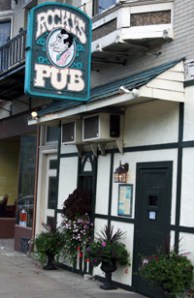
Rocky’s Pub on Mansfield’s town square.
MANSFIELD, OH. – For many people, me included, one of the fun parts of traveling is discovering the local flavor. While many of us think of that as wine, it certainly is restaurants, arts, and much more.
I travel for work in the fall and love to explore restaurants. Two years ago during a trip to Northwest Ohio my traveling companion and I discovered Rocky’s Pub in Mansfield, Ohio.
We dined there again Friday night and it really was delightful. Passing judgment on a restaurant should mirror reviewing wine. You have to judge the wine, or restaurant, for what it is. There are great $12 bottles of wine and great $250 bottles of wine. But they are different animals – the same goes for restaurants.
Rocky’s Pub is certainly not a pub at all. While the name Rocky conjures up the image of pub food and toughness, this 37-year Mansfield fixture is fine dining on the town square in this community of 47,000 – best known for its nearby Mid-Ohio racetrack.
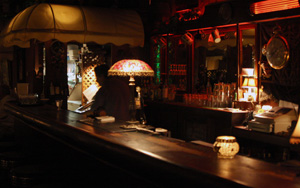
It’s the kind of place you might walk by, and without a recommendation, never walk in. It’s rather roughhewn on the exterior as the photo shows. Inside it’s dark with strings of lights, stained glass and candles.
The quirky bar was full at 7 p.m. but had emptied by 9.
But it’s about the food and wine, isn’t it? Executive Chef Sally Nesta serves up a consistent menu of Norwegian Salmon, Italian standards, Lake Erie Walleye, Scrod, and nightly specials. The Friday night specials included a spicy stuffed pepper, Kobe Ribeye, and rack of lamb.
The wine list was varied with the usual markups. It was weighted to the bottom of the price scale with Woodbridge and Kendall Jackson prevalent. But it also included a Barolo, Chateau St. Jean Cabernet, a meritage from Washington state, and Wente Chardonnay.
I had the rack of lamb with rosemary that was perfectly cooked to medium rare. It was moist and delicious. My only complaint was it needed a little salt and pepper. My dinner companion had the wild mushroom pasta that he described as flavorful with wonderful mushrooms.
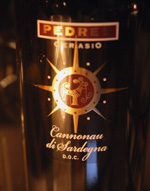
I scoured the wine list and we ordered a $29 bottle of Cantina Pedres Cerasio Cannonau. Or you can call it Grenache from Sardinia, Italy. It was light in body but pleasant with nice fruit and a soft finish. It worked well with my lamb and the pasta. Judging from the markup on the other labels, the wine was marked up 100 percent from retail.
The sides, salad, and a wonderful crusty bread were as good as you’ll find in most fine dining restaurants.
My only squibble with Rocky’s was the staffing. Our waitress was wonderful but overworked. By my count, she had 8-9 tables on a busy Friday night. There are about 25 tables in the restaurant excluding the bar. On top of serving, the waitresses had to bus tables as well. One bus boy/girl could make a big difference in the customer service.
If you have reason to drive into Northeastern Ohio along I-71, Rocky’s Pub in Mansfield is worth the trip off the interstate, five miles perhaps. It’s an old-fashioned fine dining restaurant that seldom exists in most cities. The food is quite good and atmosphere a tad eclectic. Most diners are going to love it.

Sorry I’ve Been Gone! Back Soon!

It feels like I’ve abandoned my wine writing at times recently. It’s not that, it’s really just way too much going on in life.

For Example:

A. Moving my elderly mother.
B. Moving myself across town.
C. Start of a new school year.
D. Launching a new college website.

So I’m busy. In about another week things should return to normal and I’ll be back posting at least a couple times a week. I just added my latest newspaper column. I have some reviews to get onto the site.

And coming soon I’ll have a host of video interviews from my July trip to Oregon’s Willamette Valley.

Thanks for your patience.

Send comment or questions to: hewitthoward@gmail.com

Synthetics & Screw Caps: Cork Fights Back

Cork, synthetics, screw caps, and now glass closures can bring wine geeks to a furious debate.

For nearly 300 years cork was the wine closure of choice for the wine industry. But synthetic corks and screw caps have made major inroads in the wine market. Cork’s downfall started in the early 80s when a Swiss researcher discovered TCA – or cork taint. Even cork industry promoters will admit cork taint does exist. But the big debate is whether it’s in a mere fraction of all bottled wine or up to 10 percent of all wines using cork closures.

There is also the phenomenon of cork taint. Too often the cork is blamed for a bad bottle of wine when a host of other factors can cause the wine to taste bad. Another way to look at the argument is how much you care if your $10 bottle of Cabernet is corked? Sure, you are aggravated it has to be poured down the drain but it’s just $10. On the other hand, higher end wines use cork almost exclusively. Last winter I had to pour out a $75 bottle of Pinot Noir I was saving for a special occasion. I was not a happy wino!
 

“Taint is the most misunderstood and misreported issue in the wine world “contends a cork advocacy group, 100PercentCork.org. “The taint typically associated with wine corks is TCA (2,4,6-trichloroanisole). It’s a harmless but ubiquitous environmental compound that gives wine a must flavor at very low concentrations.”

The advocacy group acknowledges cork taint but points out the contamination can also come from bottling equipment, airborne molds or chlorine-based compounds in wineries and cellars. 100PercentCork has made use of research conducted by Purdue University ‘s Christian Butzke. His research was published in the May/June 2008 Vineyard & Winery Management.

“TCA is no longer a major problem for the U.S. wine industry,” Butzke said. The Purdue Associate professor notes many bagged vegetables can be affected by the same compound but consumers write off any smell to “earthiness.”

But for many wineries and consumers the cork is out of the bottle. Plastic closures were the rage not too many years ago but seem to have fallen out of favor recently. You’ll still find many wines with synthetic corks. I often found them too soft and easily pulled out of the bottle or so hard I had to go to the gym before prying a synthetic opener out. Screw caps offer a great alternative. A screw cap eliminates oxidation but the jury remains out on how well wines will age with a screw cap. Conversely, most wines in a screw cap are at the lower end of the price scale and unlikely to be put down for aging.

I purchased a wonderful and relatively expensive bottle of Pinot during a recent Oregon trip and it had a glass closure. Glass stoppers don’t require an opener and provide a tight seal with a plastic liner. Oxidation is still under testing but appears to hold up over time. It also provides a nice look of sophistication.

Cork has lost market share to these new closure products. But it’s hard to imagine the great wines of the world ever using anything but cork. There is plenty of scientific evidence, not to mention the romance, of popping a cork from a fine bottle of wine with little worry.

For consumers and Grape Sense readers, you are sooner or later going to buy a bad bottle of wine. But your concerns and efforts are better used on selecting a good value bottle than worrying about cork taint.

Send comment or questions to: hewitthoward@gmail.com

Plenty of Summer Remains for a Dry Rose’

Dry Rose’ has become a cause for many who take wine seriously. No, it’s definitely not White Zinfandel and pink wine is not always sweet.

Rose’ wines are food-friendly and versatile. These pink wines are dry and a tremendous value. They are also some of the hottest wines, when it comes to sales, in the summer market.

Dry, pink wine really has skyrocketed the past few years. As a matter of fact, sale of Rose’ wines priced above $8 grew more than 53 percent between 2007 and 2008.
Dry Rose’ is affordable, delicious, east to pair with food and yet delightful on a summer evening with nothing but a cracker or snack foods.

Most Rose’ is made from traditional red wine grapes. The wine is simply left in contact with the grape skins for less time than red wine. You get less tannin in the wine and more balanced fruit flavor. Rose’ wines have hints of strawberry and other red fruit. Rose’ can also be made from just about any red wine grape.

Rose’ is my summer guilty pleasure. Here are the four best Rose’ wines I’ve found this summer. All of these are widely available.

Mas Donis 2010 Rosat – Spanish winemakers know how to make great Rose’. This inexpensive Rose is 80 percent Grenache, 10 percent Syrah and 10 percent Merlot. It is a full-bodied wine that will give you hints of red fruit, smoky flavors, and nice acidity. The Mas Donis stands out for its beautiful nose. Some Rose’ can be pretty flat when you stick your nose in the glass. You’ll love the wave of strawberry you get when you take a whiff of this $8-$12 wine.

Andieux & Fils Cotes de Provence
– French Rose’ is every bit as finessed and delicate as you would expect. The A&F Rose’ is refreshing and lighter than the Rosat. The blend is 60 percent Grenache and 40 percent Syrah. It has a salmon color with beautiful hints of red raspberry, strawberry, and even a hint of apricot or maybe peach on your palate. Like most Rose’, this wine has low alcohol at just 12.5 percent.

Banfi Rosa Regale – And if you really want to try something different pick up this delicious sparkler. Banfi is one of the most recognized wine names in Italy. They make this beautiful sparkling Rose’ that would be a marvelous before or after-dinner delight. Strong raspberry is lush on the mid palate. The bubbles are really quite restrained. The dark red cranberry color is beautiful. The alcohol is a ridiculously low 7 percent. This is the most expensive wine on the list at $20.

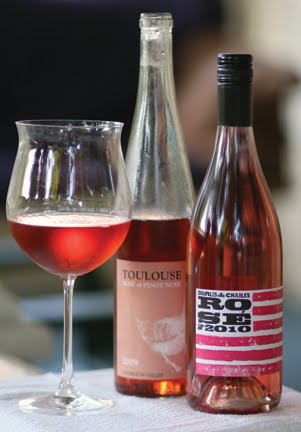
Charles & Charles 2010 Rose – Rose from Spain, France and Italy, and of course now one from the U.S.A. Charles Smith, of the two Charlies in the name, is one of Washington state’s best known, controversial, out-spoken and talented winemakers.

This Rose’ is 100 percent Syrah and it rocks. It’s the best I’ve tasted this summer and maybe one of the best I’ve ever had. It is big in flavor – think sage, raspberry, and maybe even a Jolly Rancher. This wine is proof you can enjoy world class wine for $10-$13.

Finally, I’d also suggest seeking out Pinot Noir Rose for Pinot loves. Most Pinot Rose’ is going to be above the price points mentioned here but the well-made Pinot Rose’ is a palate-pleasing treat.

Send comment or questions to: hewitthoward@gmail.com

If Local Means Local Shouldn’t That Include Wine?

So much has been written in recent years about the local food movement. Restaurants have sprung up across the nation espousing the ‘farm-to-fork’ movement.

For the unititiated, it’s simply buy local produce and use local products on the restaurant table. I travel enough to get in and out of lots of restaurants and I’m constantly surprised how few ‘farm-to-fork’ operations maintain the ‘local’ concept when it comes to wine.

The same can be said for any restaurant whether its part of the farm-to-fork movement or not.

A somewhat pleasant surprise occured over the weekend visiting the historic Key West Shrimp House in Madison, IN. The Shrimp House had several area Indiana wines on their menu. They had wines from the Thomas Family Winery and Madison Vineyards.

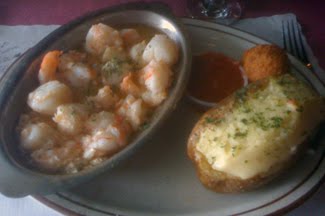
In photo at right was my Saturday night entree: A shrimp, scallops and crab meat platter with sides.

Additionally, Madison Vineyards labels makes a Key West Shrimp House label exclusively for the restaurant.

Unfortunately, I didn’t find the remainder of the wine list very interesting. For a place that serves fish, you would hope to find one Sauvignon Blanc or perhaps even a Seyval Blanc or an Indiana wine similar to a Sauv Blanc – there are plenty! I was suprised and pleased to find Mondavi’s very nice Fume Blanc on the list but it was available only by the bottle.

The restaurant has a long history. Many years ago there were multiple Key West Shrimp House locations across Indiana including Indianapolis. The first one opened in Indy in the 50s. The Madison location opened in 1968 and continues as a family-run restaurant today.

The food is good. It’s what you would expect in land-locked Indiana. I’m assuming most all of the product comes in frozen but the sides have a homemade quality most would enjoy.

In the last year I’ve been in Michigan and Wisconsin wine regions and those areas often struggle to get local wines into restaurants. Hats off to Scott Koerner at Key West Shrimp House for bringing local vintners’ wines to Madison regulars and tourists!

Send comment or questions to: hewitthoward@gmail.com

Basking in Oregon’s Pinot Noir Afterglow

(Published July 28, 2011) – A wine trip to Oregon’s Willamette Valley July 18-22 served as a reminder why so many folks love wine country travel and good wine.

The trip was mostly personal vacation but also an opportunity to casually interview a few folks and gather some material for a few newspaper columns, Madison Magazine in Anderson, and the national online wine magazine – Palate Press.

Visiting 16 wineries in four days, and tasting approximately 50-plus wines, re-invigorated my love for sharing these stories. It’s not just the juice in the glass and the Willamette Valley’s incredible Pinot Noir but it’s the people, the food, the environment that makes a wine hobby so much fun.
As the resident wine geek for a number of folks, most requests revolve around Pinot Noir. Perhaps that’s because of Sideways, the run-away hit movie from 2004 which turned Pinot into a national sensation.

So let’s get that out of the way first. In the value Pinot category, I always recommend Mirrasou, Concannon, and Flipflop. All three labels have a nice, but very light, Pinot under $10. You can’t go wrong. If you want a little stronger Pinot flavor and will go up to $15, look for Mark West, Dashwood, or Castle Rock.

With that noted, I’ll put my wine geek hat on and head back to Oregon. Most value Pinot is very thin though some are well made. Oregon’s entry level Pinot Noirs start around $25-$35 price range.

But you really have to taste one of the wonderful Pinots at or near the upper price level to appreciate the grape. Additionally, I’d argue, tasting the upper-end Pinot will help you better select value brands.

Two suggestions that aren’t way off the price charts are Lange Willamette Valley and Domaine Serene Yamhill Cuvee. Both are widely available in the Midwest. The Lange wine retails around the $20 price point while Domaine Serene will range from $27-$32. Think of it as a special occasion wine if that is outside your normal comfort level.

The wine-writing thing opens doors. I chatted with three prominent winemakers, had appointments at several wineries and all were fantastic experiences. But it was the people behind the tasting room counters who made the trip. During our first three stops everyone recommended we visit Vidon Winery, a spot I knew nothing about. It turned out to be one of the best visits and awesome Pinot.

But that experience was the rule not the exception. We met two 25-year-olds at different wineries doing some of the grunt work who aspire to be winemakers. I was able to greet some old friends from two previous trips.

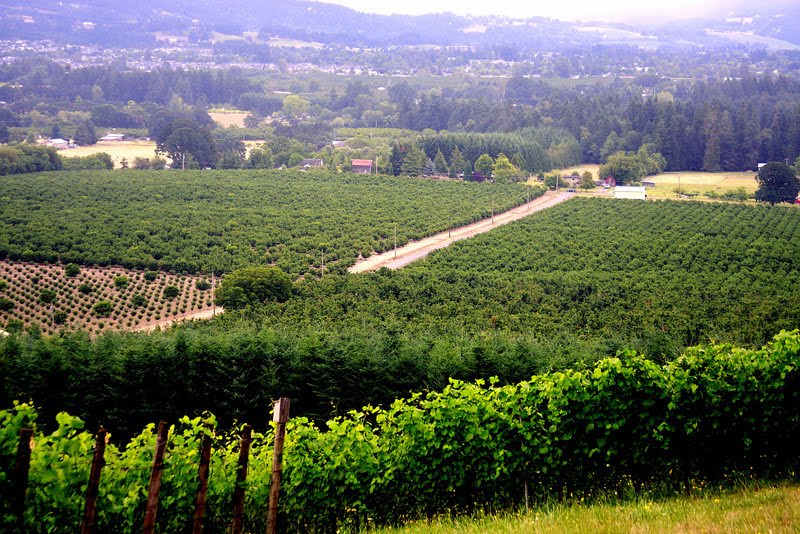
In photo at left, one of the magnificent views of the Willamette Valley. This shot was taken at Anderson Family Vineyards.

The people who make the wine aren’t just winemakers. Two columns ago I wrote about wine country travel and urged readers to talk to those people who are pouring the wine. The Oregon trip really drove that point home again.

Finally, for those ready to open their wallets here are a few recommendations or “Best of” from my trip: Lange Estate Vineyard Pinot ($60), 2009 Penner-Ash Dussin Vineyard Pinot ($60), Domaine Drouhin 2007 Laurene ($65), and Domaine Serene’s Etoile Vineyard Chardonnay ($40). All are available in better Indiana and Illinois wine shops and some liquor stores.

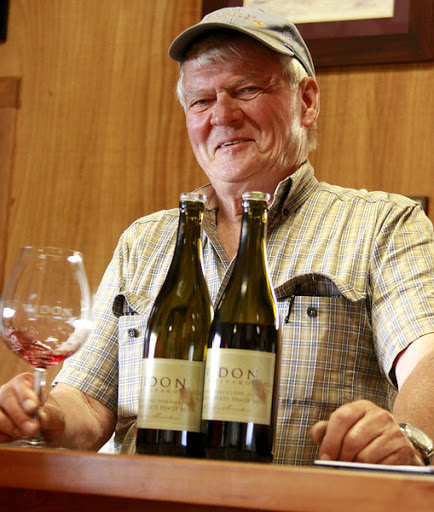
In photo at upper right is Don Hagge owner and winemaker at Vidon Vineyars, one of the best Pinots I tasted. His wines can be hard to find in most states, though.

Finally, one of the most enjoyable stops was at Republic of Jam in Carlton. Two ladies take Oregon’s magnificent fruit and turn it into unbelievable taste combinations. Many of their savory delights can be used in cooking. Look them up online and order some jam!

Editor’s Note: See four albums of photos from my Oregon trip by clicking on My Wine Travel in the right rail.

Send comment or questions to: hewitthoward@gmail.com

Vertical Offers Raunch, Fun Romp of Pinot, Pathos

Mr Rogers died, American troops invaded Iraq, and Saddam Hussein was captured. The year was 2003. Do you think you could persuade any reasonable Pinot Noir winemaker that a small-budget Hollywood movie would turn their world upside down?

Rex Pickett’s Sideways hit the screens in 2004 and nothing has been the same for Pinot, and certainly Merlot, since. It remains rather remarkable to this day how often the movie comes up when you visit regions known for their Pinot Noir. Marketers, winemakers, and tasting room folk credit Miles and Jack for the boom in Pinot popularity and sales.

If you love Pinot or just reading about wine you know the story. Now, Pickett is back along with Miles and Jack and gallons of Pinot Noir in Vertical. It’s the Sideways sequel.

The novel was released last year and talk of a Sideways follow-up has stayed hot since. During an October 2010 visit to Paso Robles, locals were discussing a possible movie. And having completed the novel, there is no question itwill be coming to a screen near you.

The Vertical story picks up after Sideways. Miles novel is made into a wildly successful movie and he’s in big demand. Buddy Jack is divorced and has hit hard times. Miles’ elderly mother is in failing health in Southern California and wants to go live out her life with a sister in Wisconsin. It’s not hard to see another road trip coming. Miles recruits Jack, packs up Mom, hires a Filipino caretaker and they’re off through California wine country and then to Oregon before taking Mom home.

Miles has been invited to host the International Pinot Noir Festival in McMinnville setting the scene for more over-the-top drunkness and sex.

Pickett has mastered storytelling and attention to detail but he’s shown no ability to exercise self control. Wading into the first few chapters you might be shocked by the raunchy descriptions of the orgies centered around Miles and Jack.

Pickett includes a level of detail on the sexual forays of our favorite author that just didn’t advance the story. It often reads awkward and out of place. It goes from making the reader uncomfortable to worse when Jack suffers from a problem erectile dysfunction medications warn you about in their wonderfully odd commercials.

But he does tell a wonderful story that serves as a screenplay for what could be another very successful movie. There is plenty of sex, winery name dropping, Willamette Valley wonderfulness, and Pinot Noir. It’s really a two-part novel. The first two-thirds of the book is the two buddys’ madcap roadtrip with the final third of the pages serving as a moving novelette about a middle-aged man dealing with the health and well-being of his aged mother.

Pickett has been spending time on Sideways for the stage. There seems little question Vertical the movie can be far behind.

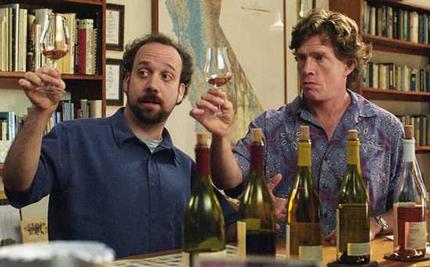
If moviemakers can sign Paul Giamatti and Thomas Haden Church for Miles and Jack, a hit seems assured. How about Betty White in a serious dramatic role as Miles’ Mother?

If you like wine and good story telling you’re going to like Vertical. Or, you can just wait for the movie that’s sure to follow.

Send comment or questions to: hewitthoward@gmail.com

Concannon’s Crimson & Clover Big Fruity/Silky Feel

I’ve been a fan of Concannon wines even before their savy marketer Stephen Mitchell put me on their samples list.

I jumped at the chance to have dinner with John Concannon earlier this summer when he was working with his distributor visiting retail outlets in Indiana. He usually does one media availabilty per trip, he told me.

So, at Stephen’s urging I’m sure, Concannon used that one media availability with me and gave me a bit of a scoop. He told me Concannon was about to add a fifth wine to their dynamite lineup of Conservancy wines.

The new wine would be called “Crimson & Clover” honoring his father, Jim. Jim Concannon was the first to bottle Petit Sirah as a varietal and is a real icon in California.

The wine was introduced this week on Jim Concannon’s 80th birthday.

My samples of the new wine arrived yesterday. I was little worried by our heat, but opened a bottle tonight with a ribeye off the grill. The wine will be popular. Seldom can you find a big, fruit-forward red wine with a nice silky texture like this one for $15.

The wine is a blend of 50 percent Petit Sirah, 25 percent Cabernet, 15 percent Syrah, and 10 percent Zinfandel. It gets plenty of time in oak – 18 months in French and American wood. The alcohol is relatively low at 13.7 percent.

Though not particularly sophisticated, a really nice and big fruit red wine. Again, I urge people to judge wine at the price point. And for $15, this is darn good wine.

I wrote a newspaper column about Concannon as well which you can check out here.

I found this story about the Concannon Celebration. There are a lot more like it online.

Send comment or questions to: hewitthoward@gmail.com

Willamette Valley, Day 4 – It’s About the People

You can love wine, food, or model trains but in the end it’s always about the people that make standout memories.

Friday wrapped up my short visit to Oregon and the Willamette Valley and the trip just couldn’t have ended better. Sure, we tasted some insanely wonderful Pinot Noir Friday in the Dundee Hills. With names like Domaine Serene, Domain Drouhin, Winderlea, and Sokol Blosser, great wine is an expectation.

Another big highlight of this trip was meeting Don Lange, Lange Vineyards, Don Hagge, Vidon, and Cliff Anderson, Anderson Family Vineyards. And it was seeing friends like Bill Sweat and Donna Morris, Winderlea, that make visits memorable.

But while making all those awesome stops, and a few more, we met some really interesting and amazing people along the way. I learned a long time ago in the newspaper business, that everyone has a story.

Click on my “Wine Travel Photos” at right for all the week’s pictures and here for Friday’s photos.

We started our day at Winter’s Hill, an Oregon producer most have never heard about. Emily and Peter Gladhart own and operate the small tasting room and brand new winery with a panoramic view of the valley. Their daughter-in-law Delphine, who grew up in Beaujolais and Burgundy, is now the winemaker.

Emily pours the wines in the tasting room. I had visited Winter’s Hill two years ago but, frankly, had no memory of the product. Their Pinot Noir was very nice and holds up to most on the hill. It’s a great product. Emily is a quiet and unassuming woman not afraid to ask for the sell. But she clearly is living a dream in an unbelievably beautiful spot in the valley.

Anyone who loves Pinot has heard of Domaine Serene owned Ken and Grace Evanstad. We had a marvelous visit and tour thanks to Lucas Willett. Lucas has 10 years of experience in the wine industry, most of it prior to Serene spent with King Estate Winery in Southern Oregon.

Lucas (at left) gave us ample time, answered questions, and was a great host. The thing that stood out was the repeated attention to detail Serene gives their wines and entire operation. Taste the wine, it all makes sense.

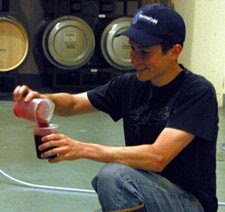
Lucas led us through the five story, gravity flow operation. Along the way we met 25-year-old Jason McCluskey who worked as an intern but so impressed the winemakers they hired him full time.

Jason (in photo at right) was preparing to balance the acidity in aging wine when we met him.

Willett had us sample the usual super lineup of Serene Pinot Noir. But he also poured a very unique white Pinot Noir. I’d never had anything like it. They make less than 200 cases and you’re not going to find it at your local wine shop. The Coeur Blanc is rich with an almost Sauternes mouth feel. At $85 a pop it’s not for everyone, but a very very unique wine.

One of my goals on this trip was hit some spots I’d previously missed. Sokol Blosser is one of the Valley pioneers in Pinot Noir. As a matter of fact, they claim their tasting room to be the very first in the Valley.

That’s where we met the entusiastic and knowledgeable Forrest Schad. Forrest (at left) was a bit over-the-top enthusiastic but it was hard not to enjoy the guy’s enthusiasm. He grows some grapes with his father and a few acres of his own. Ask him about his future plans and you’ll get, “I want to be the winemaker at Sokol Blosser.”

He poured the lineup for us and it was outstanding juice from top to bottom. They might have the best Rose’ of Pinot Noir I’ve tasted. The Blosser 2008 Dundee Hills Pinot rocked!

At that point in the day I really didn’t think things could improve much and it was just past noon. But an appointment at Domaine Drouhin blew us away.

I met and interviewed Laurent Drouhin for Palate Press in the spring of 2010. When I told him I had visited the Willamette Valley twice but never DDO he admonished me. So I had to make it up to Drouhin this trip.

We were greeted by DDO Managing Director David Millman, a most gracious host. We had so much fun talking out in the vineyard we almost never got the winery tour started.

David walked us through the beautiful facility and a tasting of Drouhin’s wines. Along the way we met a very young icon – Arthur Drouhin, the fifth generation of the Burgundy family.

David shared a great story of how Burgundy wines afte often named for family daughters but never sons. Apparently young Arthur felt slighted and mother Veronique, winemaker for DDO and Joseph Drouhin, asked family patriarch Robert for permission. But Burgundy families are all about the tradition and the elder Drouhin said no.

Veronique didn’t give up easily though and eventually Robert gave his permission to put a boy’s name on a white, instead of the traditional red, wine. The Arthur Chardonnay is widely distributed.

Arthur admitted he frequently gets asked about his plans to join the family business, and understandably at 16 he isn’t so sure. He was in Oregon on a three-week visit to work in the winery and work on his English.

One of the cool things at Drouhin is the ability to taste Veronique’s great DDO wines and then compare them to one of her bottles from Burgundy. The “Laurene” Pinot at $65 isn’t cheap for the average consumer, but about as good as Oregon Pinot gets.

We also got the chance to taste a 1999 vintage of the Willamette Valley Pinot. The current release is the entry point for DDO wines at $40. The 1999 is available in the tasting room for $100 – the taste indicated a bottle would be worth every nickel.

The wines on Thursday and Friday just blew us away. I brought a few back with me. A hint for wine country travelers. Always check the fee for a second bag if you’re traveling with just one checked piece of baggage.

With the record heat I couldn’t ship by ground, air shipping is about $10 a bottle. I brought my wine back for a $35 second-bag charge and it arrived just fine. A suggestion, though, is to find a local UPS store and have the wine professionally packed.

I like it when my Pinot rides home with me.

I do have some other odds and ends about this trip I’ll get up in the coming days. I am going to put together a video about the trip for Palate Press but that will be a few weeks away. I have some cool video clips too just for the blog.

This year I faced a choice of visiting Drew Casey, Wabash Class of 2012 and his family, or going to my first Wine Bloggers Conference. That was an easy choice but I’ve always wanted to attend WBC.

I learned today Portland was selected as host for next year’s conference.

What perfect timing!

Send comment or questions to: hewitthoward@gmail.com
Willamette Valley, Day 3 – Day of the Dons

Three days in wine country bring me to the always tough struggle of wanting to share the wine experience through my writing and enjoying a real vacation.

I posted Thursday’s photo album to my Facebook page but didn’t get it posted here last night. But I was productive this morning. Drew shot nearly all these phots, nearly 30 in the Thursday album here.

Thursday was simply one of the best “wine days” I’ve ever had. Magnificent Oregon Pinot Noir combined with three interesting and gracious winemakers made for a great day with my friend Drew.

I’m not going to write great detail, rather I’ll let the photo album and cutlines do the talking. Lange wines have long been one of my favorites. We started our day by going high up in the Dundee Hills – 750 feet above sea level to be exact – and tasting their incredible wines.

During a 2009 trip I met Jesse Lange and learned a lot about the Lange operation. I had an appointment scheduled with Jesse for yesterday but he had to cancel at the last minute. Instead, patriarch Don Lange joined us and I was thrilled. Don Lange is one of the real Willamette Valley pioneers and a soft spoken, funny, gracious man.

For those who don’t know, Don made his living as a songwriter and musician before starting the vineyards. His college degree is in poetry. It seems more than poetic and beyond my words at 7 a.m. (without coffee) to draw the obviously and symbolic ties in his life. But what a great guy!

Our second stop was just as interesting for differen reasons. Cliff and Allison Anderson planted vineyards in the early 90s and sold their grapes to other producers for years. Now they are making their own wines – Pinot Gris, Chardonnay, and Pinot Noir. They don’t have a tasting room, no signs point to their property, and furthermore, Cliff says they never will.

“We want to provide the type of experience I’d like to have,” he said. They have plenty of visitors and welcome anyone who’d like to visit and taste their wines but don’t want the rat race of a tasting room. At Anderson, the wines will be poured by Cliff or Allison. It’s the type of experience you get frequently in Willamette Valley but not the better known names. It’s also the type of experience that barely exists in California and bigger producing areas.

Everyone told us we had to visit Vidon Winery and we did Tuesday. Don Hagge, owner, winemaker, and local legend, missed us and invited us back. So yesterday we went back to see Don. Don worked in the Apollo space program and is as vigorous today approaching 80 years old as anyone you’ll meet.

He takes a unique approach to his wine making. He uses three Pinot clones which he bottles individually and then blends them for his popular “Three Clones” wines. We tasted the 08 and 09 which were quite different. I seldome use words like “silky, stunning, and elegant” but his wines were that and more.

Our day concluded at another valley icon Lynn Penner Ash. We did the Pinot flight in a crowded tasting room and enjoyed the view.

Today is my last day here and it’s doing to be another big one. If yesterday was “Day of the Dons” today will be “Domain Day.” We’re off this morning to visit and tour the highly-regarded Domaine Serene and then this afternoon Domaine Drouhin. We’ll sneak a couple more visits in and then it’s dinner in downtown Portland tonight and a redeye flight home.

Send comment or questions to: hewitthoward@gmail.com